Microfiber is a high-tech textile composed of extremely fine synthetic fibers—typically a blend of polyester and polyamide. While it is prized for its high absorbency and soft hand-feel, it presents unique challenges during production. Microfiber is a weft-knitted fabric, meaning it is prone to curling at the edges, snagging on rough surfaces, and creating significant amounts of lint during the trimming process.
To produce professional-grade microfiber towels for the automotive, cleaning, or beauty industries in 2026, you need machinery that can handle high-speed production while maintaining delicate edge control. Here is your guide to choosing the best sewing machines for microfiber towel production.
For the majority of microfiber towels, especially those used for cleaning, the 3-thread overlock (or serger) is the industry standard. It provides a narrow, secure edge that prevents the knit loops from unraveling while minimizing thread consumption.
Differential Feed: This is non-negotiable for microfiber. Because the fabric is stretchy, you need a machine that can "gather" the fabric slightly as it sews to prevent the edges from becoming wavy or "lettuce-edged."
High-Speed Trimming: Microfiber towels are usually cut from large rolls. A machine with integrated carbide steel knives will ensure a clean, flush cut before the threads encase the edge.
Tension Versatility: Microfiber varies in GSM (grams per square meter). Your machine must be able to adjust tension quickly to switch from a lightweight 200 GSM glass cloth to a heavy 500 GSM buffing towel.
For premium towels or heavy-duty floor mats, a 4-thread overlock provides an extra line of reinforcement. This "safety" needle ensures that even if one thread is snagged during a rigorous cleaning task, the entire hem won't fail.
Mock Safety Stitch: This creates a wider, more durable border often seen on high-end "edgeless" style towels where the edge is actually a decorative overlock stitch.
If you are producing luxury towels with folded hems rather than overlocked edges, a coverstitch machine is required.
Elasticity: The coverstitch allows the hem to stretch with the microfiber without the thread snapping.
Bottom Looper Protection: The "loopy" stitch on the underside of a coverstitch protects the raw edge of the folded fabric, preventing the microfiber from "running" or laddering after repeated use.
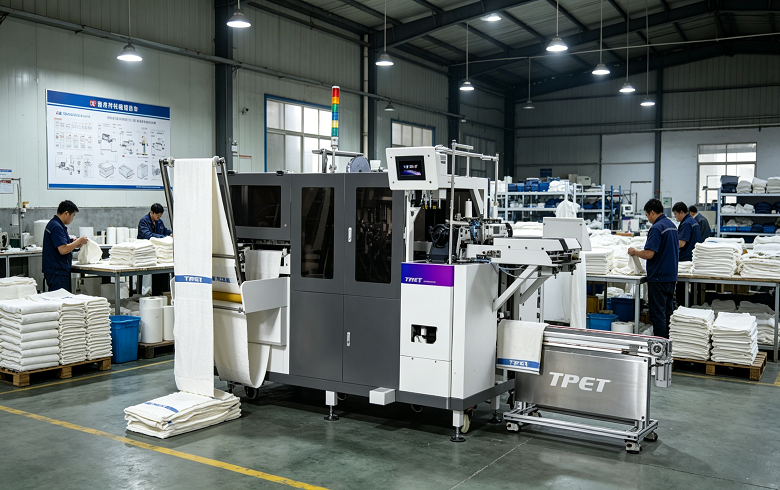
In a modern production facility, manual sewing is often supplemented by automated stations to ensure consistency across thousands of units.
For mass production, "longitudinal hemming" machines process long rolls of microfiber, while "cross hemming" machines cut them to size and finish the ends.
Pile Scanning Sensors: Modern machines use sensors to detect the height of the microfiber pile, automatically adjusting the presser foot pressure to prevent "crushing" the soft fibers.
Pneumatic Label Feeders: These units automatically insert brand labels into the hem during the sewing cycle, reducing human touchpoints.
Microfiber generates a unique, sticky lint that can quickly clog machine internal gears.
Vacuum Suction Systems: High-end industrial units are now equipped with pneumatic tubes that suck away fabric trimmings and lint directly from the knife area.
Oil-Free (Dry Head) Technology: To prevent oil from wicking into the absorbent microfiber, 2026 models often feature "dry" or "semi-dry" heads that use sealed grease instead of circulating oil.
| Factory Scale | Recommended Machine | Best For |
| Boutique / Small Batch | Juki MO-6800D | Versatile, semi-dry head for clean production. |
| Mid-Size Production | Pegasus M900 Series | High speed (7,000 RPM) with excellent durability. |
| Industrial / Automated | TEXPA Longitudinal Hemmer | Fully automated roll-to-towel production. |
| Specialty (Auto-Care) | Yamato AZ Series | Precise tension control for very high GSM towels. |
Use Ball-Point Needles: Standard sharp needles can cut the knit loops of microfiber, causing "runs." Ball-point needles (SES/SUK) push the fibers aside rather than piercing them.
Thread Choice: Use a textured polyester thread (like Woolly Nylon or Bulky Poly) in the loopers. This provides a softer edge and better coverage over the raw fabric.
Knife Maintenance: Microfiber is abrasive. Expect to sharpen or replace your trimming knives 20% more often than you would with standard cotton fabrics.
Choosing the right sewing machine for microfiber towel production is a balance between speed and material handling. By prioritizing machines with differential feed, lint suction, and non-stain technology, you ensure that your final product is not only durable but also clean and professional. As the demand for specialized cleaning textiles grows in 2026, the right equipment allows your factory to scale without sacrificing the "soft touch" that defines the microfiber industry.

The TPET ET-6620 Automatic Pillow Cover Machine (US Type) is a high-efficiency, intelligent solution designed to revolutionize the production of American-style pillowcases, tailored to meet the demands of modern textile manufacturing. Built for speed...

The TPET ET-5816/GG 2nd Generation Automatic Terry Towel Length Hemming Machine is a state-of-the-art solution designed to revolutionize towel production efficiency and quality. As the main drafting unit of the industry standard “Automatic towe...

The ET-6628 Envelope Pillow Case Machine: A Milestone in Automated AB-Side Envelop Production From TPET Company.In the competitive landscape of modern textile manufacturing, efficiency, precision, and versatility are paramount. The ET-6628 Envelope P...

Equipped with advanced magnetic navigation technology, the autonomous vehicle ensures accurate path following and stable operation.

This automatic delivery vehicle is equipped with magnetic navigation technology and is designed for seamless integration with production lines.

 EN
EN