In today’s global manufacturing landscape, sustainability is no longer an optional direction—it has become a core requirement. As governments, brands, and consumers increasingly shift toward environmentally responsible products, eco-friendly shopping bags have rapidly replaced single-use plastic bags in retail, supermarkets, and promotional markets. This transformation has created a growing demand for reliable, efficient, and durable sewing solutions that can support large-scale production of reusable bags.
For manufacturers, the key challenge is not only producing eco-friendly shopping bags in high volume but also ensuring they are strong, reusable, and capable of withstanding long-term use. At the heart of this process lies one essential factor: stitching quality. Durable stitches determine whether a shopping bag can endure repeated carrying, heavy loads, and daily wear. This is where advanced eco-friendly shopping bag sewing machines play a critical role in modern textile production.
TPET, as a provider of intelligent industrial sewing solutions, focuses on delivering high-performance sewing machines designed specifically for durability, speed, and precision. In this article, we explore how durable stitching technology enhances eco-friendly shopping bag production and how modern sewing machines are reshaping the industry.
The global movement against plastic waste has significantly accelerated the adoption of reusable shopping bags. Retailers and consumers alike are shifting toward materials such as cotton, canvas, non-woven polypropylene, jute, and recycled fabrics. These materials are durable, washable, and reusable, making them ideal for sustainable consumption.
However, producing eco-friendly bags is not as simple as switching materials. These fabrics often require stronger needle penetration, reinforced seams, and consistent stitching patterns. Unlike disposable plastic bags, reusable shopping bags must withstand repeated stress, weight, and environmental exposure.
This shift has placed sewing technology at the center of sustainable manufacturing. Without strong and consistent stitching, even the highest-quality eco-friendly materials can fail prematurely, undermining both product value and environmental goals.
Durable stitching is the foundation of a high-quality shopping bag. It directly impacts three critical aspects: strength, lifespan, and user experience.
First, strength ensures the bag can carry heavy loads such as groceries, books, or daily essentials without tearing at the seams. Weak stitches often lead to seam failure, especially at stress points like handles and bottom joints.
Second, lifespan is essential for sustainability. The longer a shopping bag can be reused, the lower its environmental footprint. Durable stitches allow bags to withstand repeated washing and daily use, extending their service life significantly.
Third, user experience plays a major role in brand reputation. Consumers expect eco-friendly products not only to be sustainable but also reliable. A bag that breaks easily contradicts its environmental purpose and damages customer trust.
For manufacturers, achieving all three requires precision engineering, consistent tension control, and advanced automation—capabilities that modern sewing machines are specifically designed to deliver.
Modern eco-friendly shopping bag sewing machines are far more advanced than traditional industrial sewing equipment. They integrate automation, intelligent control systems, and high-speed performance to ensure consistent output and durable stitching quality.
One of the most important innovations is the intelligent control system. Operators can pre-set stitching parameters such as stitch length, speed, thread tension, and pattern type. Once configured, the machine executes the process with high precision, reducing human error and ensuring consistency across thousands of units.
Servo motor technology is another critical advancement. Compared to traditional motors, servo systems offer better energy efficiency, smoother operation, and more accurate control. This is especially important when working with thick or layered fabrics commonly used in eco-friendly shopping bags.
Additionally, automatic feeding systems help position fabric accurately, ensuring straight seams and reducing material waste. This improves productivity while maintaining consistent stitching alignment, which is essential for professional-grade bag production.
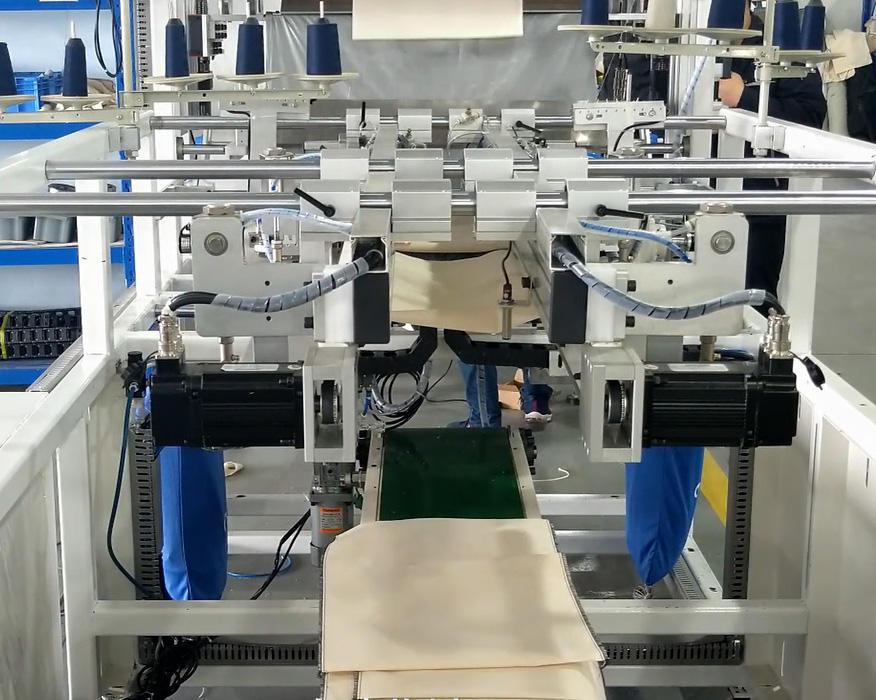
To achieve strong and reliable stitching, modern sewing machines incorporate several essential features:
Modern eco-friendly shopping bag sewing machines are designed with multiple reinforced stitching modes to ensure durability across different applications. Common stitch types such as lockstitch and chain stitch provide a strong foundation, while specialized reinforced edge stitching adds extra strength where it is most needed. These stitching options allow manufacturers to select the most suitable pattern based on the material type and bag design, ensuring optimal seam performance.
In high-stress areas like handles, side seams, and bottom corners, reinforced stitching plays a critical role in preventing tearing or seam failure. By combining multiple stitch layers or using dense stitch patterns, these machines significantly improve load-bearing capacity. This is especially important for reusable shopping bags, which must withstand repeated use and heavy loads without compromising structural integrity.
Thread tension is one of the most important factors in achieving durable stitches, as improper tension can lead to weak seams or thread breakage. Advanced sewing machines are equipped with automatic thread tension control systems that continuously adjust tension levels based on fabric thickness and sewing speed. This ensures consistent stitch formation even during complex or high-speed operations.
With precise tension management, the machine prevents common issues such as loose stitching, skipped stitches, or puckering. This level of control not only enhances seam strength but also contributes to a more professional and uniform appearance. For manufacturers, it reduces material waste and rework, ultimately improving both efficiency and product quality.
Eco-friendly shopping bags are often made from durable materials such as canvas, nonwoven fabric, or jute, all of which require robust needle systems for effective stitching. Industrial sewing machines use heavy-duty needles specifically designed to penetrate thick or multi-layered fabrics without bending or breaking. These needles maintain sharpness and strength over extended periods of operation.
In addition to durability, heavy-duty needle systems ensure precise stitch placement and reduce the risk of fabric damage. This is particularly important when working with coarse or textured materials that can be difficult to sew. By maintaining consistent needle performance, manufacturers can achieve clean, reliable seams while minimizing downtime caused by needle replacement or machine adjustments.
Automation plays a key role in improving both efficiency and stitch quality, and integrated cutting systems are a prime example. Modern sewing machines are equipped with automatic thread trimming features that cut excess thread at the end of each stitching cycle. This eliminates the need for manual trimming and speeds up the production process.
Beyond efficiency, automatic cutting and finishing contribute to a cleaner and more polished final product. Neatly trimmed threads reduce the risk of unraveling and enhance the overall appearance of the bag. For brands focused on quality and presentation, this feature ensures that every product meets high aesthetic and functional standards.
High-speed operation is essential for large-scale manufacturing, but it must be paired with stability to maintain stitch durability. Advanced sewing machines are engineered with precision components and vibration-reduction systems that allow them to operate smoothly even at high speeds. This ensures consistent stitch formation throughout long production runs.
Stable performance is particularly important when producing large batches of eco-friendly shopping bags, where uniformity is critical. Fluctuations in speed or machine movement can lead to uneven stitches or weak seams. By maintaining consistent operation, these machines guarantee reliable quality across every unit, helping manufacturers meet both production targets and quality expectations.
In addition to durability, efficiency is a key concern for manufacturers. Eco-friendly shopping bag demand is growing rapidly, especially in retail chains, promotional industries, and export markets. To meet this demand, production lines must operate at high speed without compromising quality.
Automated sewing machines significantly increase output by reducing manual intervention. Operators can supervise multiple machines simultaneously, while automated systems handle stitching, alignment, and cutting. This reduces labor costs and minimizes production errors.
Furthermore, intelligent monitoring systems allow real-time tracking of machine performance. Manufacturers can identify issues early, reduce downtime, and optimize production schedules.
The combination of speed and precision ensures that manufacturers can scale their operations efficiently while maintaining consistent product quality.
Eco-friendly products must be supported by eco-friendly production processes. Modern sewing machines contribute to sustainability not only through the products they help create but also through their operational efficiency.
Energy-efficient servo motors reduce electricity consumption compared to traditional mechanical systems. Precise stitching reduces fabric waste, while automation minimizes defective output, ensuring that fewer materials are discarded.
Additionally, longer machine lifespans and reduced maintenance requirements contribute to lower resource consumption over time. This aligns with global sustainability goals and helps manufacturers reduce their environmental footprint at every stage of production.
TPET is committed to advancing intelligent sewing technology for modern textile manufacturing. Our eco-friendly shopping bag sewing machines are designed with a focus on durability, efficiency, and automation.
We understand that manufacturers need equipment that can adapt to evolving market demands while maintaining consistent quality standards. By integrating advanced control systems, servo technology, and high-speed precision engineering, TPET machines help factories achieve stable production and superior stitching performance.
From small workshops to large-scale industrial factories, our solutions are designed to support businesses at every level of production. Whether producing promotional tote bags, retail shopping bags, or reusable packaging solutions, TPET machines ensure strong and reliable stitching for every product.
The growing demand for eco-friendly shopping bags has transformed the textile manufacturing industry. As sustainability becomes a global priority, the need for durable, reusable, and high-quality bags continues to rise.
At the core of this transformation is stitching technology. Durable stitches determine not only the strength of a bag but also its usability, lifespan, and environmental value. Modern eco-friendly shopping bag sewing machines provide the precision, speed, and automation required to meet these demands efficiently.
By investing in advanced sewing technology, manufacturers can enhance productivity, reduce costs, and contribute to a more sustainable future. TPET remains dedicated to supporting this transition with intelligent, high-performance sewing solutions designed for the next generation of eco-friendly manufacturing.

The TPET ET-6620 Automatic Pillow Cover Machine (US Type) is a high-efficiency, intelligent solution designed to revolutionize the production of American-style pillowcases, tailored to meet the demands of modern textile manufacturing. Built for speed...

The TPET ET-5816/GG 2nd Generation Automatic Terry Towel Length Hemming Machine is a state-of-the-art solution designed to revolutionize towel production efficiency and quality. As the main drafting unit of the industry standard “Automatic towe...

The ET-6628 Envelope Pillow Case Machine: A Milestone in Automated AB-Side Envelop Production From TPET Company.In the competitive landscape of modern textile manufacturing, efficiency, precision, and versatility are paramount. The ET-6628 Envelope P...

Equipped with advanced magnetic navigation technology, the autonomous vehicle ensures accurate path following and stable operation.

This automatic delivery vehicle is equipped with magnetic navigation technology and is designed for seamless integration with production lines.

 EN
EN