In the fast-paced bedding industry of 2026, the transition from manual sewing to semi-automation is the defining step for mid-sized manufacturers looking to scale. A Semi-Auto Pillow Cover Machine acts as the perfect middle ground: it retains the flexibility of human oversight while introducing mechanical speed for the most repetitive tasks, such as long-seam stitching and edge trimming.
By integrating machines like those from TEPT, factories can significantly reduce "seam-to-seam" time, ensuring that every pillow cover is uniform, durable, and ready for high-volume retail.
Fully automatic lines are excellent for massive runs of identical products, but they can be rigid. A semi-automatic setup allows an operator to quickly switch between different fabric types—like cooling silk, organic cotton, or heavy flannel—without a full technical recalibration.
Increased Throughput: While a manual operator might produce 30-40 covers an hour, a semi-auto machine can double or triple that output by automating the feeding and trimming cycles.
Consistency in Quality: Human fatigue leads to uneven seam allowances. Semi-auto machines use guided tracks and pneumatic tensioners to ensure every stitch is perfectly parallel to the edge.
Reduced Labor Strain: The machine handles the "heavy lifting" of pulling large fabric panels through the needle, reducing repetitive motion injuries and improving long-term operator productivity.
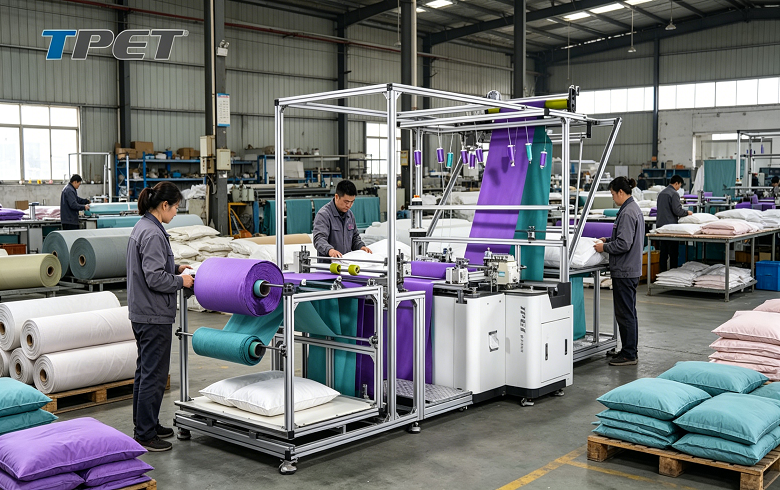
When selecting a machine for a 2026 production line, look for these advanced technical specifications:
The machine typically features a long conveyor or a clamping rail. The operator simply aligns the fabric at the start, and the machine "takes over," sewing the entire length of the pillowcase at speeds up to 4,000 stitches per minute.
Rather than having a separate station for finishing, modern semi-auto machines are "all-in-one" units.
Carbide Steel Knives: These trim excess fabric flush to the seam as the machine sews.
Overlock (Serging): The machine simultaneously encases the raw edge, preventing fraying during the pillow-filling process or consumer washing.
In 2026, TEPT machines come standard with IoT-enabled sensors.
Thread Break Detection: The machine stops instantly if the upper or lower thread snaps, preventing "ghost seams" that waste fabric.
Automatic Bobbin Monitoring: Sensors alert the operator when the bobbin is at 10% capacity, allowing for a planned swap that minimizes downtime.
| Feature | Manual Sewing Station | Semi-Auto Pillow Machine |
| Output (Units/Hr) | 35 - 50 | 120 - 180 |
| Consistency | Variable (Human dependent) | High (Mechanical precision) |
| Setup Time | Instant | 5 - 10 Minutes (For style change) |
| Operator Skill | High (Expert seamstress) | Moderate (Technician-guided) |
Semi-auto machines are precision instruments that require a disciplined maintenance schedule to avoid line stoppages.
Daily Lint Evacuation: Pillow fabrics—especially fleece or brushed cotton—generate massive amounts of lint. Use integrated suction systems or manual compressed air to clear the needle plate every 4 hours.
Needle Rotation: Change needles every 8-shift hours. A dull needle on a high-speed machine will heat up and melt synthetic threads or snag delicate cooling-gel fabrics.
Oil Quality Checks: Ensure the automatic oiling system is pumping clear, high-grade spindle oil. If the oil appears amber, it is contaminated with fabric dust and must be flushed.
The Semi-Auto Pillow Cover Machine is the engine of growth for modern bedding brands. It provides the scalability required for large e-commerce orders while maintaining the hand-finished quality that premium customers expect. By investing in semi-automation, you aren't just buying a sewing machine—you are buying the consistency and speed that allows your business to compete on a global stage.

The TPET ET-6620 Automatic Pillow Cover Machine (US Type) is a high-efficiency, intelligent solution designed to revolutionize the production of American-style pillowcases, tailored to meet the demands of modern textile manufacturing. Built for speed...

The TPET ET-5816/GG 2nd Generation Automatic Terry Towel Length Hemming Machine is a state-of-the-art solution designed to revolutionize towel production efficiency and quality. As the main drafting unit of the industry standard “Automatic towe...

The ET-6628 Envelope Pillow Case Machine: A Milestone in Automated AB-Side Envelop Production From TPET Company.In the competitive landscape of modern textile manufacturing, efficiency, precision, and versatility are paramount. The ET-6628 Envelope P...

Equipped with advanced magnetic navigation technology, the autonomous vehicle ensures accurate path following and stable operation.

This automatic delivery vehicle is equipped with magnetic navigation technology and is designed for seamless integration with production lines.

 EN
EN