The textile industry remains one of the most resilient and profitable manufacturing sectors worldwide. Among its many product categories, towels stand out as a consistently high-demand item. From hotels and hospitals to gyms and households, towels are used daily and replaced frequently. This steady demand makes towel production an attractive opportunity for entrepreneurs seeking to establish a manufacturing business.
Starting a towel production business may seem complex, but with the right planning and equipment—especially a reliable towel making machine—it is possible to build a scalable and profitable operation. This guide explores how entrepreneurs can launch their own towel manufacturing business, what equipment is required, and how to maximize profitability in this growing market.
Towels are essential textile products used across multiple industries. The hospitality sector alone consumes millions of towels each year due to constant replacement and hygiene standards. In addition, the rise of home décor trends and personal care products has increased consumer demand for high-quality bath linens.
Several factors make towel production a strong business opportunity:
First, demand is stable and recurring. Towels wear out over time, which means customers frequently reorder them. Hotels, resorts, spas, and healthcare facilities require continuous supply.
Second, production technology has become more accessible. Modern towel making machines allow small and medium manufacturers to produce high-quality towels with improved efficiency.
Third, product variety creates multiple market segments. Businesses can produce bath towels, hand towels, kitchen towels, gym towels, or luxury spa towels, each targeting different customers.
Because of these factors, towel manufacturing offers both domestic and export potential for new entrepreneurs.
Before investing in machinery, it is important to understand the basic towel production workflow. Towel manufacturing involves several steps, each supported by specialized equipment.
The process typically includes:
Yarn preparation – Cotton fibers are spun into yarn suitable for weaving. Cotton remains the most popular material because of its softness and absorbency.
Weaving – Terry towel looms create the looped pile structure that gives towels their absorbent texture.
Dyeing and finishing – Towels are dyed, softened, and treated to achieve the desired color and texture.
Cutting and sewing – Fabric is cut into towel sizes and stitched along the edges to prevent fraying.
Inspection and packaging – Finished towels are inspected for defects, folded, and packaged for distribution.
Some manufacturers invest in a full production line, while others focus only on certain stages such as cutting and finishing.
Once production begins, businesses should focus on improving efficiency and expanding sales channels.
One important strategy is product diversification. Offering multiple towel types—such as bath towels, beach towels, baby towels, and luxury spa towels—allows manufacturers to reach different customer segments.
Another key strategy is quality control. High-quality towels with consistent stitching and soft texture help build long-term customer relationships.
Branding and packaging can also increase product value. Attractive packaging makes towels more appealing for retail sales and online marketplaces.
Finally, efficient production management helps reduce waste and lower operating costs. Modern towel machines with automated controls can significantly improve productivity.
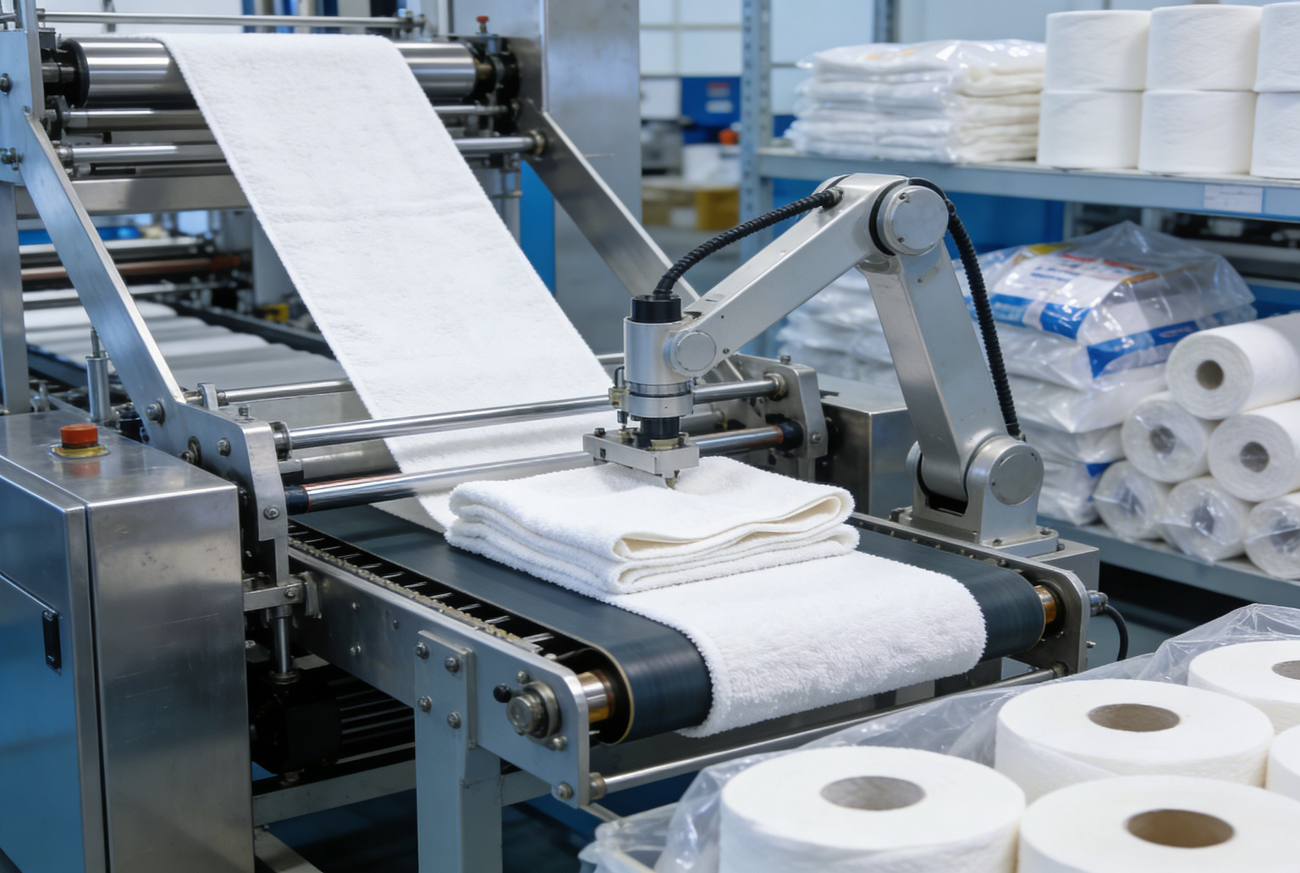
Starting a towel manufacturing business requires several types of investment beyond the machine itself.
Typical startup costs include:
Towel making machines – Depending on automation level, machines may range from a few thousand dollars to over $100,000.
Factory space – A small production workshop may require 200–500 square meters, depending on machine size.
Raw materials – Cotton yarn, dyes, and packaging materials must be purchased before production begins.
Labor – Operators, technicians, and quality inspectors may be needed depending on the scale of operations.
Utilities – Textile machinery consumes electricity, water, and sometimes steam.
For small manufacturers, an initial investment of $30,000–$80,000 can be sufficient to start a basic towel production facility.
A successful towel business depends on identifying the right customers. Fortunately, towels are used across many industries.
Common target markets include:
Hotels and resorts
Hospitals and healthcare facilities
Fitness centers and gyms
Retail stores and supermarkets
Online e-commerce platforms
Some manufacturers specialize in private label production, producing towels for brands that sell them under their own labels. This model can be especially profitable for small factories.
Export markets are another major opportunity. Countries with growing tourism sectors often import large quantities of hotel linens and bath towels.
As demand grows, businesses can expand production capacity by adding more machines or upgrading to advanced automated systems.
Expansion strategies may include:
Installing additional towel looms
Adding automated folding and packaging systems
Developing new towel designs or custom embroidery services
Expanding into international markets
Scaling production gradually allows companies to grow while maintaining financial stability.
Starting a business with a towel making machine can be a rewarding investment for entrepreneurs entering the textile industry. With steady global demand and a wide range of market opportunities, towel production offers strong potential for long-term profitability.
Success depends on selecting the right machinery, maintaining consistent product quality, and targeting the right customers. By combining reliable equipment with smart business strategies, entrepreneurs can build a competitive towel manufacturing operation and establish a sustainable presence in the textile market.

The TPET ET-6620 Automatic Pillow Cover Machine (US Type) is a high-efficiency, intelligent solution designed to revolutionize the production of American-style pillowcases, tailored to meet the demands of modern textile manufacturing. Built for speed...

The TPET ET-5816/GG 2nd Generation Automatic Terry Towel Length Hemming Machine is a state-of-the-art solution designed to revolutionize towel production efficiency and quality. As the main drafting unit of the industry standard “Automatic towe...

The ET-6628 Envelope Pillow Case Machine: A Milestone in Automated AB-Side Envelop Production From TPET Company.In the competitive landscape of modern textile manufacturing, efficiency, precision, and versatility are paramount. The ET-6628 Envelope P...

Equipped with advanced magnetic navigation technology, the autonomous vehicle ensures accurate path following and stable operation.

This automatic delivery vehicle is equipped with magnetic navigation technology and is designed for seamless integration with production lines.

 EN
EN