Imagine you’re a roll of towel material, fresh off a giant roll and ready to be transformed into your final form. In TEPT (Suzhou Transparent Technology Co., Ltd.)’s high-speed manufacturing facilities, your transformation into a premium product begins with a cut. Precision cutting is the first step in the smart factory. When your edges are a millimeter or two off, your 4-side hemming and robotic folding processes will be misaligned, which will increase B-grade products and material waste.
As a National “Specialized and Sophisticated” Small Giant Enterprise, TEPT has innovated in the field of towel cutting to go beyond knives and blades to AI-enabled 100% consistent cutting for both cotton and microfiber products.
Cutting towel material is challenging. Unlike apparel cotton, towel terry cloth is thick, elastic, and has a tendency to “creep” when a blade is applied to it. Conventional cutting equipment often experiences:
Pile Compression: The loops can force a physical blade to wander and leave a ragged edge.
Elasticity: Unless properly tensioned, the material may shrink or grow once it has been cut, affecting product sizing.
Fraying: Unsealed microfiber and low-twist cotton can quickly fray once cut.
TEPT’s precision cutting machines combine mechanical and optical technologies to overcome these challenges.
By 2026, a cutting machine without the ability to measure more than just length will be outdated. TEPT’s cutting systems use a range of sensors to understand the material’s structure in real-time.
Terry Loop Recognition (Gap Detection)
High-quality towels have “flat” sections between each towel unit, providing a clear channel for cutting. TEPT cutting machines employ high-speed fiber-optic sensors to detect these channels.
How it works: A sensor detects the density change in the material at a micro level.
The benefit: The cutting blade lands in the middle of the flat weave, preserving loop shearing and preserving the visual appeal of the hem.
AI Vision Pattern Tracking
Jacquard towels or towels with borders require more than length measurement since material may “bow” or “skew” during drying.
The technology: An HD camera reads patterns and borders in real-time.
The benefit: The AI processor compensates for skew by adjusting the cut angle on-the-fly. This keeps borders parallel to the cut edge, a key requirement for luxury towels.
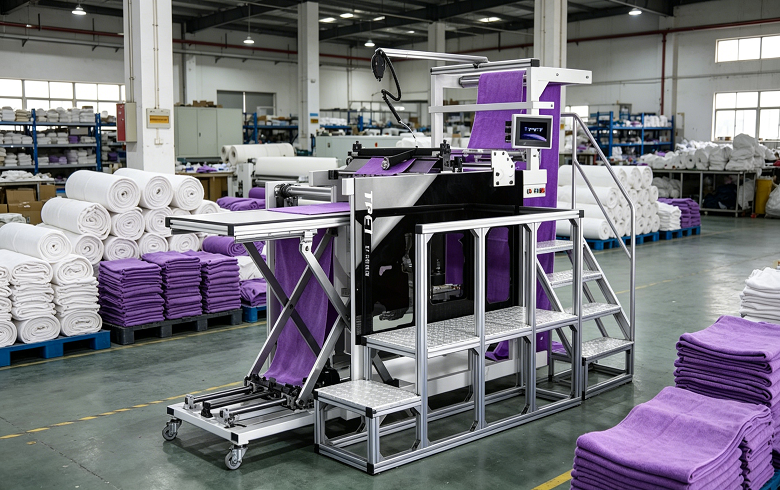
TEPT supplies a range of cutting modules that can be selected based on material and production objectives.
High-Velocity Mechanical Blades For high-volume cotton towel production, mechanical cutting is the most economical option. TEPT uses Tungsten Carbide rotary knives or oscillating blades. Why: These blades are harder than conventional steel and remain sharp after millions of cuts. How: Mechanical cutters used in a TEPT 4-side sewing line are synchronized with the feed dogs to provide zero-tension cutting.
Laser Cutting (The microfiber specialist) Microfiber, a blend of polyester and polyamide, has a strong tendency to fray. The process: A concentrated beam of CO2 laser energy vaporizes the fibers as it cuts. The “seal”: The laser energy instantly cauterizes the material edge. The result: Many microfiber products feature edges so smooth they no longer require hemming, saving production time and thread.
Ultrasonic Slitting Medical and surgical towels demand the utmost cleanliness and softness. Ultrasonic cutting relies on high-frequency blade motion to “buzz” through fibers. The advantage: Produces a soft, non-abrasive edge without heat-induced discoloration or carbonization, ideal for stringent, lint-free medical/surgical applications.
Towel cutting generates more lint than almost any other textile process. Without proper maintenance, this lint becomes "packing" that can overheat motors and dull blades.
High-Pressure Air Cleaning: Blow out the knife housing every 4 hours.
Blade Replacement: Even with self-sharpening systems, blades should be inspected daily for microscopic chips that cause "snagging" on terry loops.
Sensor Calibration: Dust buildup on infrared sensors can lead to "ghost cuts." Wipe optical lenses with anti-static solution once per shift.
Precision cutting is the foundation of a durable towel. When a machine produces a clean, straight edge, the subsequent hemming is faster, the thread tension is more consistent, and the final product looks "high-end" to the consumer. In 2026, investing in automated pile-sensing technology and vacuum-stabilized tables is the most effective way to eliminate human error and drive factory profitability.

The TPET ET-6620 Automatic Pillow Cover Machine (US Type) is a high-efficiency, intelligent solution designed to revolutionize the production of American-style pillowcases, tailored to meet the demands of modern textile manufacturing. Built for speed...

The TPET ET-5816/GG 2nd Generation Automatic Terry Towel Length Hemming Machine is a state-of-the-art solution designed to revolutionize towel production efficiency and quality. As the main drafting unit of the industry standard “Automatic towe...

The ET-6628 Envelope Pillow Case Machine: A Milestone in Automated AB-Side Envelop Production From TPET Company.In the competitive landscape of modern textile manufacturing, efficiency, precision, and versatility are paramount. The ET-6628 Envelope P...

Equipped with advanced magnetic navigation technology, the autonomous vehicle ensures accurate path following and stable operation.

This automatic delivery vehicle is equipped with magnetic navigation technology and is designed for seamless integration with production lines.

 EN
EN