A common mistake when sourcing a factory sewing machine is letting the price tag drive the decision while ignoring what the material actually demands. Cotton sheeting behaves differently from terry cloth, and stretch knit differs from woven polypropylene. The right machine handles the fabric without puckering, skipped stitches, or excessive thread breakage. Material weight, weave density, and stretch percentage should all be mapped against the feed mechanism, needle system, and presser foot pressure range before a single unit gets quoted.
ISO 4915 defines six stitch classes, and the factory sewing machine category spans at least four of them in daily production. Lockstitch (Class 300) offers tight, non-raveling seams ideal for apparel topstitching. Chainstitch (Class 100 and 400) provides stretch tolerance suited to knitwear and home textiles. Overedge (Class 500) finishes raw edges at speed. Choosing the wrong class means rework, fabric damage, or line bottlenecks, none of which a production schedule can absorb. A factory floor in central Vietnam learned this the hard way when a batch of 8,000 microfiber cleaning cloths started fraying within two wash cycles. The root cause was a lockstitch machine running where a four-thread overlock should have been deployed. The corrective retrofit cost the operation three days of downtime.
Manufacturers tend to advertise maximum stitches per minute, but experienced production engineers look at feed consistency first. Drop feed works for stable wovens. Compound feed, which combines needle and walking foot movement, prevents ply shift in multi-layer assemblies. Differential feed stretches or gathers fabric as needed, a critical feature when transitioning between dissimilar materials on the same line. A machine running at 3,500 SPM with erratic feed wastes more material per shift than a 2,800 SPM unit delivering straight, even seams every time.
A basic factory sewing machine requires an operator to position, guide, and trim every piece. Semi-automated workstations add pneumatic clamping, edge sensors, and auto-trim functions that reduce handling time. Fully automatic lines integrate cutting, labeling, stacking, and sometimes even visual inspection into a single pass. The payoff depends on order profiles: high-mix, low-volume shops often find that semi-automation protects flexibility, while long-run commodity lines see the fastest ROI from full automation. The calculus changes when labor availability shifts, a reality that hit several Southeast Asian textile parks between 2022 and 2024 as worker turnover pushed factory managers toward higher automation tiers earlier than budgeted.
| Build Factor | Entry-Level Range | Mid-Range Industrial | High-End Automated Line |
|---|---|---|---|
| Frame Construction | Stamped steel, bolt-together | Welded tubular steel | Heavy-gauge welded frame with reinforced plates |
| Motor Type | Clutch motor (single speed) | Servo motor (variable speed) | Direct-drive servo with programmable torque |
| Stitch Consistency at 2,500+ SPM | +/- 0.8mm variance | +/- 0.3mm variance | +/- 0.15mm variance |
| Typical Lifespan (single shift) | 3 to 5 years | 8 to 12 years | 15+ years with PM schedule |
| Operator Training Curve | 2 to 4 weeks | 1 to 2 weeks | 3 to 5 days with on-screen guidance |
A machine that sits idle for two weeks waiting on a replacement needle bar or PCB is not an asset; it is a liability. When sourcing, the question to ask is not just about warranty length but about local parts inventory, remote diagnostic capability, and whether the manufacturer maintains technical staff in the buyer's region. This lesson became painfully clear during 2023 supply disruptions in the Red Sea corridor, where factories dependent on European-origin spare parts faced lead times stretching past 60 days while those with Asian-based suppliers with regional warehouses kept lines running with 48-hour turnaround.
Certifications matter too. CE marking confirms baseline safety and EMC compliance, while the industry standard for automatic towel sewing systems, for which the main drafting body is a recognized Chinese industry leader, provides a reference benchmark for machine reliability in home textile applications. Buyers who cross-reference these standards against their own incoming QC protocols catch specification drift before machines land on the factory floor.
For operations scaling up towel, bedding, curtain, or cleaning-textile lines, TPET offers factory sewing machines built around modular platform designs and in-house servo control systems. The engineering approach emphasizes material-handling precision and integration readiness, which helps production teams shorten commissioning timelines and keep post-installation adjustments to a minimum.

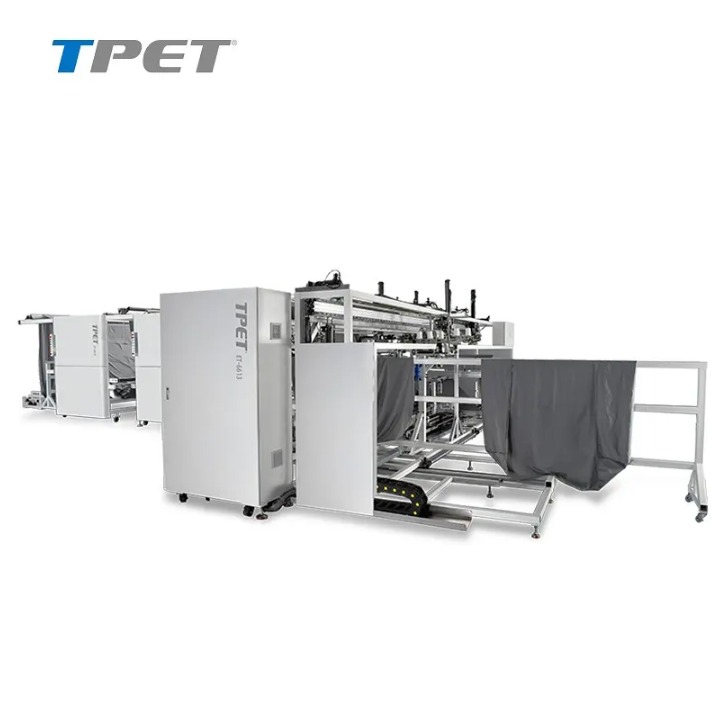
The TPET ET-6620 Automatic Pillow Cover Machine (US Type) is a high-efficiency, intelligent solution designed to revolutionize the production of American-style pillowcases, tailored to meet the demands of modern textile manufacturing. Built for speed...

The TPET ET-5816/GG 2nd Generation Automatic Terry Towel Length Hemming Machine is a state-of-the-art solution designed to revolutionize towel production efficiency and quality. As the main drafting unit of the industry standard “Automatic towe...

The ET-6628 Envelope Pillow Case Machine: A Milestone in Automated AB-Side Envelop Production From TPET Company.In the competitive landscape of modern textile manufacturing, efficiency, precision, and versatility are paramount. The ET-6628 Envelope P...

Equipped with advanced magnetic navigation technology, the autonomous vehicle ensures accurate path following and stable operation.

This automatic delivery vehicle is equipped with magnetic navigation technology and is designed for seamless integration with production lines.

 EN
EN