Kitchen towels present a combination of demands that frustrate general-purpose sewing equipment. The fabric is typically terry, waffle weave, or a cotton-linen blend with a loose, absorbent structure that shifts under the presser foot and generates substantial lint. Raw edges fray aggressively because the weave is designed to maximize surface area for water absorption. A standard lockstitch machine, running without proper edge treatment, produces hems that roll, pucker, or shed threads after the first hot-water laundry cycle. The consequence for volume manufacturers is not just a cosmetic defect but a return rate that eats directly into margin on a product category where wholesale unit prices rarely exceed a few dollars.
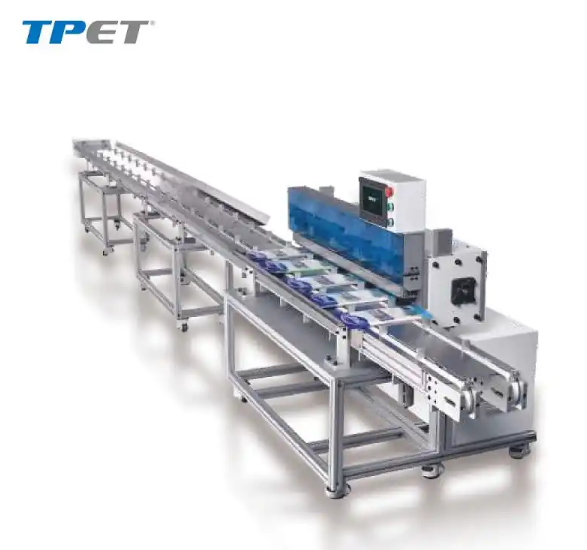
A dedicated dish towel sewing machine differs from a general-purpose unit in one critical aspect: it combines edge finishing and hemming into a single automated pass. The machine typically uses a fabric-guiding system that folds the raw edge under once, then folds it again, creating a clean double-fold hem before the needle even reaches the material. On high-speed variants, the cut piece gets fed continuously from a stack, passing through folding plates, a trimming knife, and the stitching head in sequence. Manual handling, where an operator folds, aligns, and feeds each piece individually, caps out around 180 to 220 pieces per hour. An automated hemming line easily reaches 600 to 900 pieces per hour with one operator loading stacks into the feeder.
A kitchen textile factory supplying a major North American home-goods retailer reconfigured its dish-towel finishing section in early 2025, replacing four standard single-needle sewing stations with two automated hemming lines. The per-unit labor cost dropped by roughly 40%, and hem-width consistency improved from a range of 4mm variation to under 1.2mm, which brought the line within the retailer's revised visual-quality threshold that had triggered a quality-alert notice six months earlier.
Terry loops catch on standard smooth presser feet, causing irregular feed motion that translates to wavy hems and inconsistent stitch length. A dish towel sewing machine designed for this material class uses a walking foot or compound feed that grips the top and bottom fabric surfaces simultaneously, pulling both layers forward at the same rate. For waffle-weave fabrics with their characteristic grid texture, a roller presser foot reduces contact friction while maintaining feed control. The differential feed adjustment, which allows the front and rear feed dogs to move at slightly different speeds, handles the stretch that occurs when hemming across the bias of loosely woven cotton-linen blends.
| Production Method | Pcs/Hour (Single Operator) | Hem Consistency | Edge Fray Prevention | Labor Cost Per 1,000 Pcs |
|---|---|---|---|---|
| Manual Single-Needle | 180 to 220 | ±3mm to ±5mm | Separate overlock pass needed | Baseline |
| Semi-Automated Hemming | 400 to 550 | ±1.5mm to ±2mm | Integrated folding plates | ~45% below baseline |
| Fully Automated Hem-Fold-Sew Line | 600 to 900 | ±0.8mm to ±1.2mm | Auto-trim plus folding system | ~60% below baseline |
Kitchen towels survive an unusually harsh lifecycle: hot water, bleach-based detergents, high-heat drying, and frequent use cycles that can hit 3 to 5 washes per week in a commercial kitchen setting. A three-thread overedge stitch wrapped around the folded hem provides the best combination of edge security and launderability. Some manufacturers add a secondary chainstitch row 3mm inside the overedge for visual structure, creating what the trade calls a safety-hem finish. The overedge stitch wraps the raw edge in a thread casing that physically prevents individual yarns from working loose, while the internal chainstitch holds the fold in position. Testing by the Hohenstein Institute in Germany on commercial laundry durability shows that double-fold hems secured with overedge stitching survive roughly 300 wash cycles before showing measurable edge degradation, compared to 120 to 150 cycles for a standard double-fold lockstitch hem on identical towel material.
The limitation is worth noting: overedge hemming adds roughly 4mm to 5mm to the hem width, which shifts the finished-towel dimensions. Brands with tight size tolerances for retail packaging need to account for this in their cutting specifications, or they risk carton-fit issues downstream.
Beyond the hemming head itself, a modern dish towel sewing machine production cell often includes an inline cutting module that squares the fabric panel before folding, a pneumatic label inserter that places a care-label strip into the hem fold during stitching, and an automatic stacker at the output end that counts and aligns finished pieces. The integration logic is straightforward: every manual transfer between stations is a quality risk and a labor cost. The tradeoff is that fully integrated cells require more floor space and a higher upfront capital commitment than standalone machines. A mid-size operation producing 15,000 to 30,000 dish towels per month typically finds the return-on-investment point for full integration somewhere between 18 and 30 months, depending on local labor rates and order consistency.
For manufacturers supplying the hospitality, retail, and commercial kitchen sectors where dish-towel volume and hem quality are both non-negotiable, TPET offers automated production systems that combine precision folding plates, overedge or chainstitch heads, and integrated material handling in a single compact line configuration.

The TPET ET-6620 Automatic Pillow Cover Machine (US Type) is a high-efficiency, intelligent solution designed to revolutionize the production of American-style pillowcases, tailored to meet the demands of modern textile manufacturing. Built for speed...

The TPET ET-5816/GG 2nd Generation Automatic Terry Towel Length Hemming Machine is a state-of-the-art solution designed to revolutionize towel production efficiency and quality. As the main drafting unit of the industry standard “Automatic towe...

The ET-6628 Envelope Pillow Case Machine: A Milestone in Automated AB-Side Envelop Production From TPET Company.In the competitive landscape of modern textile manufacturing, efficiency, precision, and versatility are paramount. The ET-6628 Envelope P...

Equipped with advanced magnetic navigation technology, the autonomous vehicle ensures accurate path following and stable operation.

This automatic delivery vehicle is equipped with magnetic navigation technology and is designed for seamless integration with production lines.

 EN
EN