A double needle lock stitch machine forms two independent ISO 301 lockstitches in a single operation, with each needle carrying its own top thread and both sharing one or two rotary hooks underneath. The interlocking happens at the midpoint of the fabric thickness, so the stitch looks identical from both sides and neither thread loop sits proud of the surface. This symmetry explains why the double-needle lockstitch dominates visible topstitching on collars, cuffs, pocket flaps, and plackets: the seam is flat, snag-resistant, and dimensionally stable. On the production floor, the machine typically runs at 2,500 to 3,800 stitches per minute with needle spacing adjustable from about 4.8mm up to 31.8mm, depending on the gauge and bed configuration.
Dress shirts live or die on their collar and cuff topstitching. A double-needle lockstitch places two perfectly parallel rows at 6.4mm spacing along the collar band, and any deviation beyond 0.3mm is visible to a consumer holding the shirt at arm's length. Jeans manufacturing uses the same principle on the inseam and yoke attachment, where the characteristic twin-row look signals durability. Work uniform programs, particularly those governed by NFPA or EN standards, specify double-needle lockstitch construction on all primary load-bearing seams because the stitch class has zero unravel potential if one thread breaks. A single-needle 301 lockstitch can unzip from the break point, but with two independently formed locks running side by side, a failure in one line does not propagate to the other.
Beyond apparel, the double needle lock stitch machine handles a surprising range of flat-goods applications. Hemming bed sheets, pillowcases, and duvet covers with a double-row finish prevents the raw edge from rolling after repeated laundering. Table linens for the hospitality sector, washed 200-plus times per year in commercial laundries, depend on double-needle lockstitch hems to stay square and flat rather than curling into a distorted shape that refuses to drape properly. Curtain panel joining, where two widths of fabric must create an invisible vertical seam while carrying the weight of blackout lining, benefits from the lockstitch's tight, non-stretching structure that will not elongate under gravity over months of hanging.
A textile service company serving hotels across Fujian and Zhejiang tracked linen replacement costs over an 18-month period. Items hemmed with a single-needle lockstitch averaged 157 wash cycles before edge failure. Those finished on a double-needle lockstitch reached 280 cycles with the hems intact, a difference that eliminated one full replacement order cycle per year for a 45,000-piece inventory.
| Stitch Attribute | Single-Needle Lockstitch (ISO 301) | Double-Needle Lockstitch |
|---|---|---|
| Stitch Lines per Pass | 1 | 2 |
| Unravel Risk | Sequential (stitch-by-stitch) | Isolated per line |
| Seam Elasticity | Near zero | Near zero (both lines) |
| Top Thread Consumption | ~1.4x seam length | ~2.8x seam length (two needles) |
| Visual Symmetry | Single row | Twin parallel rows |
| Common Faults | Thread break, skipped stitch | Tension imbalance, needle deflection |
The most persistent quality issue on a double-needle lockstitch setup is tension imbalance between the left and right needle threads. When the left needle runs slightly looser than the right, the bobbin thread pulls through unevenly, creating a subtle ladder effect on the underside that QC inspectors catch by running a finger along the seam back. The other common headache is needle deflection when the fabric stack height changes mid-seam, such as crossing a flat-felled joint. A 0.2mm deflection at the needle tip translates to a visible 0.5mm stitch line deviation at standard 6.4mm spacing. High-quality needle bars with hardened bushings and anti-deflection guides mounted close to the needle clamp reduce this drift to acceptable limits.
The double-needle lockstitch handles cotton, linen, polyester-cotton blends, and light to medium synthetics without difficulty, provided the feed timing and presser foot pressure are dialed in for the specific material. Knits present more of a challenge because the lockstitch has essentially no stretch tolerance, so a 20% stretch knit will pucker along the seam unless the differential feed is adjusted to gather the fabric slightly ahead of the needle entry point. Heavy leather and coated fabrics above 1.2mm thickness push past the comfortable range of most double-needle lockstitch machines; a walking-foot compound-feed configuration or a dedicated post-bed setup becomes necessary at that point.
Production engineers who treat the double needle lock stitch machine as a fixed-configuration asset rather than a tunable system leave performance on the table. Regular tension calibration against a digital thread-tension meter, scheduled needle replacement every 8 to 10 operating hours on high-speed lines, and periodic hook timing checks keep stitch quality where QC specifications demand.
For factories building garment, bedding, or hospitality textile programs that depend on consistent double-row lockstitch finishing, TPET supplies industrial sewing equipment with precision needle-bar architecture and field-adjustable feed configurations suited to multi-shift production environments.

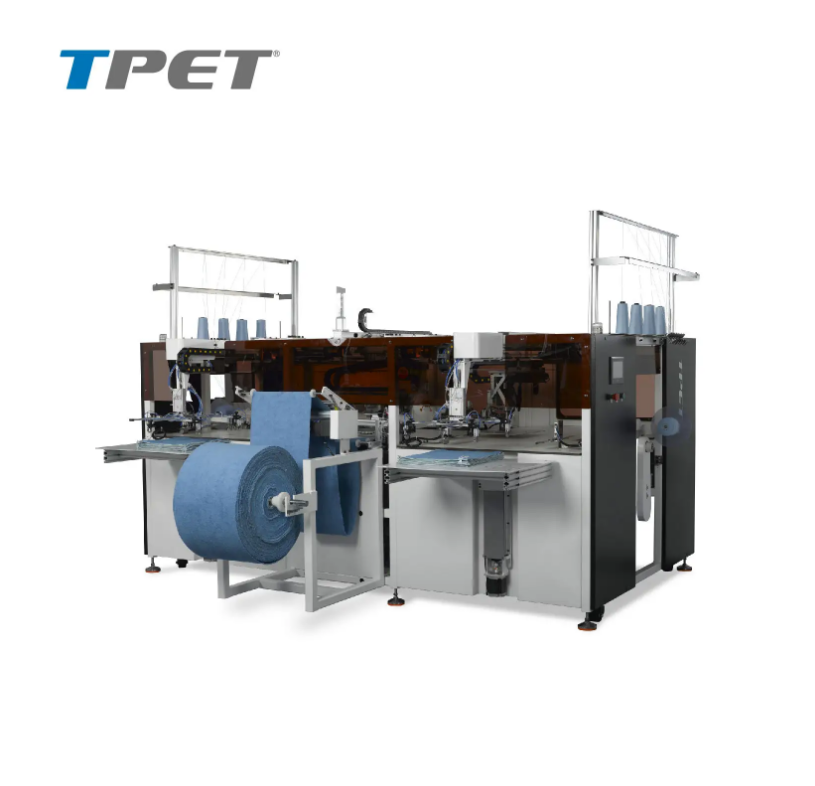
The TPET ET-6620 Automatic Pillow Cover Machine (US Type) is a high-efficiency, intelligent solution designed to revolutionize the production of American-style pillowcases, tailored to meet the demands of modern textile manufacturing. Built for speed...

The TPET ET-5816/GG 2nd Generation Automatic Terry Towel Length Hemming Machine is a state-of-the-art solution designed to revolutionize towel production efficiency and quality. As the main drafting unit of the industry standard “Automatic towe...

The ET-6628 Envelope Pillow Case Machine: A Milestone in Automated AB-Side Envelop Production From TPET Company.In the competitive landscape of modern textile manufacturing, efficiency, precision, and versatility are paramount. The ET-6628 Envelope P...

Equipped with advanced magnetic navigation technology, the autonomous vehicle ensures accurate path following and stable operation.

This automatic delivery vehicle is equipped with magnetic navigation technology and is designed for seamless integration with production lines.

 EN
EN