Investing in towel manufacturing machinery is a major decision for textile manufacturers. Whether a company is launching a new production facility or expanding its existing operations, understanding both the equipment cost and the potential return on investment (ROI) is essential. While the price of towel manufacturing machines can vary greatly depending on technology and capacity, the long-term value lies in how efficiently the equipment contributes to production output and profitability. A thorough analysis of machine price, operating efficiency, and production capability can help manufacturers make informed decisions that support sustainable growth.
The cost of towel manufacturing equipment varies widely based on automation level, production speed, and machine configuration. Smaller machines designed for low-volume operations typically require a relatively modest investment, while fully automated production systems can cost significantly more.
Generally, towel manufacturing machines can be categorized into three price levels:
Basic machines: Suitable for small workshops or startups with limited production needs.
Semi-automatic machines: Provide improved efficiency while still requiring some manual operations.
Fully automated machines: Designed for large-scale factories with high output requirements.
Although automated equipment demands a higher initial investment, it often delivers greater efficiency and productivity over time.
Several technical and operational factors determine the final cost of towel manufacturing machines. Understanding these factors allows manufacturers to choose equipment that fits both their production needs and financial plans.
Automation is one of the most important cost drivers. Machines with integrated automation systems can perform multiple processes—such as cutting, folding, and stacking—without extensive manual involvement.
While automated machines are more expensive initially, they significantly reduce labor costs and improve production consistency.
Machine capacity directly influences its price. Equipment designed for higher output requires stronger motors, more durable components, and advanced control systems.
For example, a small machine may produce only dozens of towels per hour, while high-speed industrial equipment can produce several hundred. Greater output capacity enables factories to handle larger orders and improve overall efficiency.
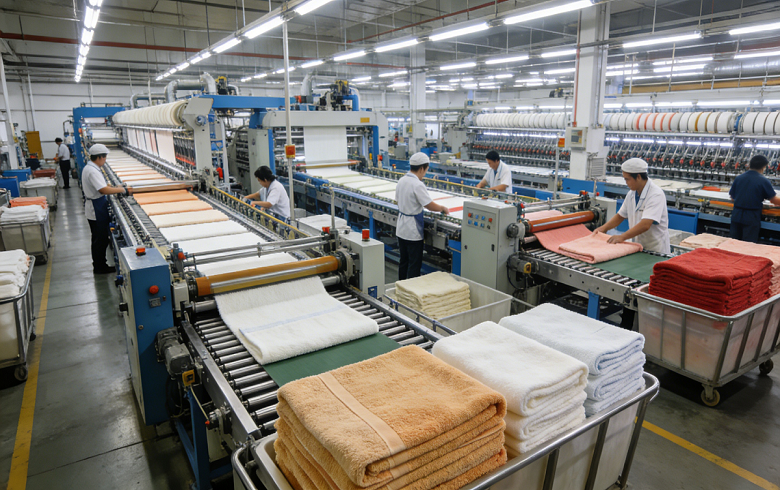
The quality of components used in the machine also impacts its price. Equipment built with high-grade motors, precision gears, and reliable electronic control systems generally costs more but offers greater durability and stability.
Machines equipped with modern control technology often provide better accuracy and easier operation, which improves production efficiency.
Some machines are designed to process only standard cotton towels, while others can produce different towel types such as microfiber or blended fabrics. Machines that support multiple material types usually require more sophisticated engineering, which can increase their cost.
However, this flexibility allows manufacturers to diversify their product offerings and serve different markets.
Return on investment measures how effectively a machine generates profit compared with its purchase cost. For towel manufacturers, ROI largely depends on production volume, operational efficiency, and product profit margins.
A simplified ROI calculation considers the following factors:
Machine purchase price
Annual production capacity
Profit per towel
Operating costs such as labor and energy
If the machine generates enough profit to recover its cost within a short timeframe, it represents a strong investment.
Consider a factory purchasing an automated towel sewing and finishing machine costing $60,000. If the machine produces 1,200 towels per day and operates for 300 days annually, the total yearly production would reach 360,000 towels.
If the manufacturer earns an average profit of $0.20 per towel, the annual profit would be $72,000. In this case, the machine could recover its initial investment in approximately one year.
This example illustrates how productivity improvements can significantly shorten the payback period for industrial equipment.
Machine price alone does not determine the true cost of production. Manufacturers must also account for ongoing operating expenses when evaluating equipment investments.
Industrial textile machines require electricity to power motors, control systems, and auxiliary equipment. Energy-efficient machines can reduce long-term operating costs and improve overall profitability.
Automation plays a key role in reducing labor costs. A fully automated towel production machine may require only one or two operators, while less advanced machines may need multiple workers to manage different stages of production.
Lower labor dependency improves efficiency and helps factories remain competitive.
Regular maintenance is necessary to ensure machines continue operating efficiently. Machines built with durable materials and reliable engineering typically require less frequent repairs and fewer replacement parts.
Choosing equipment with strong technical support and accessible spare parts helps prevent costly production interruptions.
Machine reliability directly affects profitability. Unexpected breakdowns can stop production lines and delay delivery schedules. High-quality equipment generally experiences fewer operational disruptions, allowing factories to maintain consistent output.
Automation has become increasingly important in modern textile manufacturing. Global demand for towels—from hospitality, healthcare, and retail sectors—continues to grow, requiring factories to produce larger volumes while maintaining high quality.
Automated towel manufacturing machines provide several advantages:
Faster production speeds
Reduced labor costs
Consistent product quality
Improved production management
Greater scalability for export orders
Although automated equipment requires a larger upfront investment, its ability to increase efficiency often results in stronger long-term returns.
When choosing towel manufacturing equipment, manufacturers should evaluate both technical performance and financial impact. Important considerations include:
Production capacity requirements
Available workforce and labor costs
Machine durability and maintenance needs
Flexibility for producing different towel types
Long-term operating expenses
Rather than focusing solely on the lowest purchase price, manufacturers should prioritize machines that deliver stable performance and efficient production.
Towel manufacturing machine prices vary widely depending on automation level, production capacity, and technical configuration. While initial investment costs can be significant, the true value of the equipment lies in its ability to increase productivity and generate consistent profits.
By carefully analyzing machine price, operational costs, and production output, manufacturers can estimate realistic ROI and choose equipment that supports long-term growth. In many cases, modern towel manufacturing machines recover their cost within a relatively short period while significantly improving production efficiency.For textile manufacturers aiming to expand capacity or compete in international markets, investing in the right machinery is a key step toward achieving sustainable profitability.

The TPET ET-6620 Automatic Pillow Cover Machine (US Type) is a high-efficiency, intelligent solution designed to revolutionize the production of American-style pillowcases, tailored to meet the demands of modern textile manufacturing. Built for speed...

The TPET ET-5816/GG 2nd Generation Automatic Terry Towel Length Hemming Machine is a state-of-the-art solution designed to revolutionize towel production efficiency and quality. As the main drafting unit of the industry standard “Automatic towe...

The ET-6628 Envelope Pillow Case Machine: A Milestone in Automated AB-Side Envelop Production From TPET Company.In the competitive landscape of modern textile manufacturing, efficiency, precision, and versatility are paramount. The ET-6628 Envelope P...

Equipped with advanced magnetic navigation technology, the autonomous vehicle ensures accurate path following and stable operation.

This automatic delivery vehicle is equipped with magnetic navigation technology and is designed for seamless integration with production lines.

 EN
EN