In the high-stakes world of textile manufacturing, the "finishing touch" is often the most expensive and time-consuming. For decades, the production of towels—from standard hotel bath mats to plush, luxury beach towels—relied heavily on manual labor. Rows of operators hunched over industrial sewing machines, hand-folding thick terry cloth and guiding it through needles. However, as global labor costs rise and the demand for "perfect" consistency grows, the industry is hitting a turning point. Automating the finishing process with TPET's dedicated towel hemming machine is no longer just a luxury for the giants of the industry; it has become a survival strategy.
To understand the value of automation, we first have to look at the unique "personality" of towel fabric. Unlike flat sheets or apparel cotton, terry cloth is heavy, bulky, and highly elastic. It produces a massive amount of lint and has a tendency to "creep" or stretch during sewing.
A manual operator can only maintain peak precision for a few hours. After that, fatigue sets in. Hems become uneven, labels are sewn in crookedly, and thread tension fluctuates. Furthermore, manual hemming is slow. Even the fastest operator is limited by the physical act of feeding, folding, and trimming. In a facility producing thousands of units a day, the hemming department often becomes a massive bottleneck that slows down the entire supply chain.
A modern automated towel hemming system isn't just a sewing machine; it is a sophisticated robotic workstation. These systems are typically divided into two main categories: Longitudinal (Side) Hemmers and Cross (End) Hemmers. In a fully integrated factory, these two machines are linked by a conveyor system to create a "Total Automation" line.
The process usually begins with a large roll of fabric. As the fabric unspools, the longitudinal hemmer takes over.
Automatic Edge Detection: High-speed sensors (often infrared) track the edge of the fabric to within a fraction of a millimeter.
Active Tension Control: To prevent the fabric from puckering, the machine uses "dancer rollers" that adjust the feed speed in real-time.
The Double-Turn Folder: Mechanical guides fold the edge of the fabric over twice, creating the classic, durable hem seen on high-end towels.
Once the sides are finished, the towel is cut to length. This is where the cross-hemmer comes in. This machine handles the "ends" of the towel.
Precision Cutting: High-speed blades or ultrasonic cutters slice the fabric.
Label Insertion: This is a key feature of automation. The machine can automatically place a brand or care label into the fold of the hem before the needle ever touches the fabric.
Stacking: Once finished, the towel is automatically folded and stacked, ready for packaging.
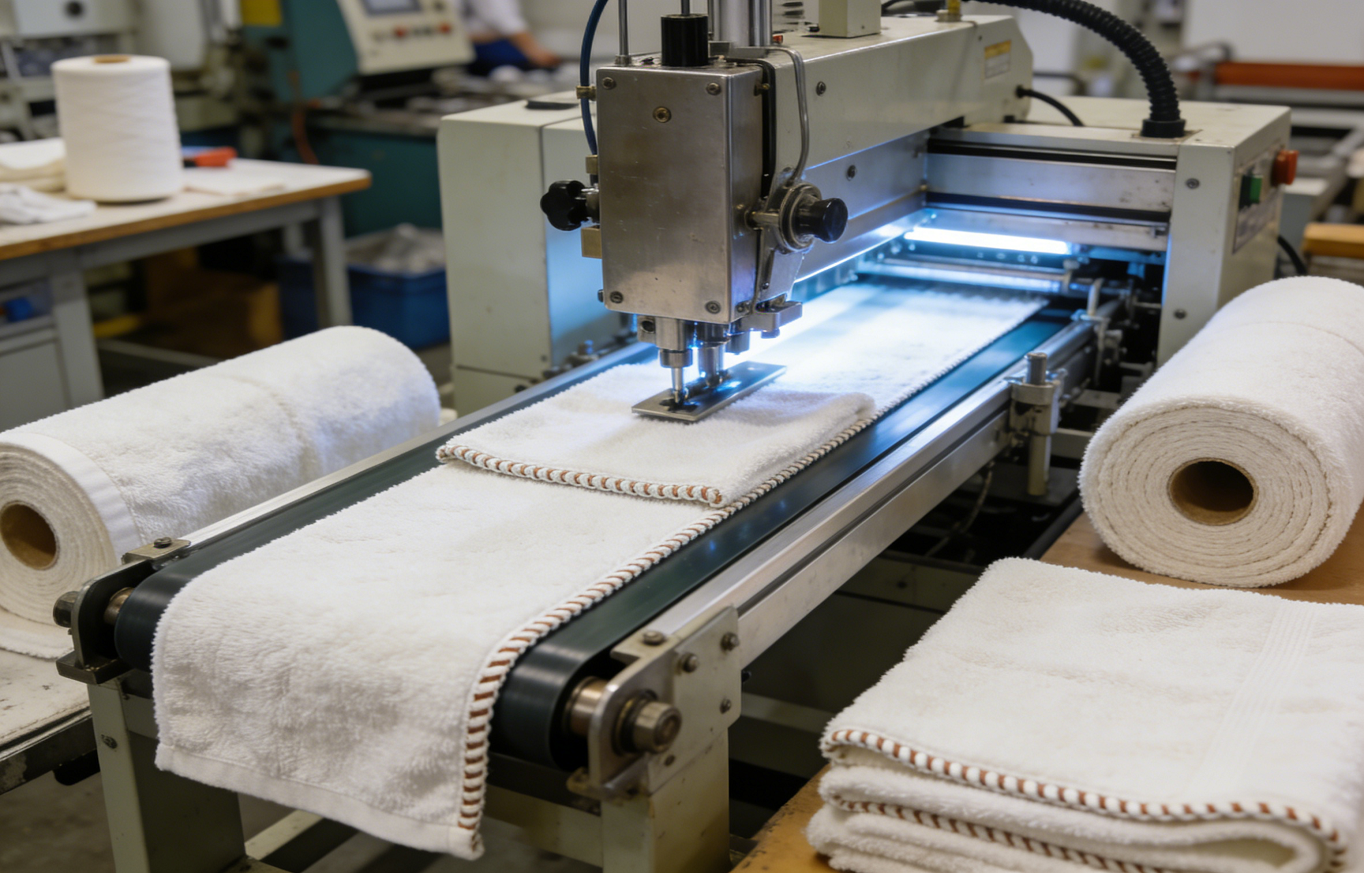
The shift to automation offers three primary technical advantages that manual labor simply cannot replicate.
Automated machines use electronic stitch-length control. Whether the machine is running at 500 or 3,000 stitches per minute, every single stitch is identical. This is crucial for towels, which undergo rigorous industrial laundering. A consistent, tight hem prevents the "unraveling" effect that often leads to product returns in the hospitality sector.
One of the biggest enemies of textile machinery is lint. Terry cloth sheds constantly. Manual stations often become "clogged," leading to machine failure. Automated lines are built with integrated vacuum extraction systems at the needle bar and looper. They suck away the lint before it can interfere with the mechanics or stain the fabric with oil.
When a human makes a mistake on a cut, that towel becomes "B-stock" or scrap. Automated systems use sensors to detect flaws in the fabric before the hem is even started. If the machine detects a missed loop or a tear in the base fabric, it can pause or mark the piece, ensuring that only 100% perfect goods make it to the final stack.
For many factory owners, the "sticker shock" of an automated hemming line (which can cost hundreds of thousands of dollars) is the biggest hurdle. However, the Return on Investment (ROI) is often realized in under 24 months.
| Metric | Manual Production | Automated Production |
| Output | ~120 towels / hour (per op) | ~900+ towels / hour |
| Labor Requirement | 10–15 Operators | 1–2 Technicians |
| Error Rate | 3–5% | < 0.5% |
| Floor Space | High (many stations) | Compact (integrated line) |
While the initial cost is high, the cost-per-unit drops significantly. By eliminating 80% of the labor cost and reducing material waste, manufacturers can compete with lower-cost markets while maintaining premium quality.
It isn’t all "plug and play." Integrating an automated line requires a shift in factory culture and technical expertise.
The Skill Shift: You no longer need 50 seamstresses; you need 2 highly skilled electromechanical technicians. These individuals must understand how to calibrate sensors and maintain PLC (Programmable Logic Controller) systems.
Thread Quality: Automation is sensitive. If you use low-quality, "hairy" thread, the machine will experience more frequent breakages. Investing in high-tenacity, lubricated thread is a prerequisite for a smooth run.
Machine Flexibility: A major pitfall is buying a machine that only does one size. Modern manufacturers like Magetron, Texpa, or Carl Schmale offer "multi-size" machines that can switch from a washcloth to a beach towel via a touchscreen interface in under five minutes.
In 2026, sustainability is no longer an "extra"—it’s a requirement. Automated hemming contributes to a "Greener" factory in subtle ways:
Reduced Energy Consumption: Modern servo motors only consume power when the needle is moving, unlike older clutch motors that run constantly.
Lower Carbon Footprint: By producing more units in a smaller footprint with less waste, the overall energy-per-towel is drastically reduced.
Longevity: Better hems mean longer-lasting towels, which reduces the "disposable" nature of textiles in the hotel industry.
The automation of towel hemming is the logical evolution of the textile industry. By removing the variability of human touch from the most repetitive part of the process, manufacturers gain speed, precision, and a massive competitive edge. The transition doesn't happen overnight, but the data is clear: the future of finishing is robotic. For companies looking to scale, the question isn't if they should automate, but how fast they can get the line running.

The TPET ET-6620 Automatic Pillow Cover Machine (US Type) is a high-efficiency, intelligent solution designed to revolutionize the production of American-style pillowcases, tailored to meet the demands of modern textile manufacturing. Built for speed...

The TPET ET-5816/GG 2nd Generation Automatic Terry Towel Length Hemming Machine is a state-of-the-art solution designed to revolutionize towel production efficiency and quality. As the main drafting unit of the industry standard “Automatic towe...

The ET-6628 Envelope Pillow Case Machine: A Milestone in Automated AB-Side Envelop Production From TPET Company.In the competitive landscape of modern textile manufacturing, efficiency, precision, and versatility are paramount. The ET-6628 Envelope P...

Equipped with advanced magnetic navigation technology, the autonomous vehicle ensures accurate path following and stable operation.

This automatic delivery vehicle is equipped with magnetic navigation technology and is designed for seamless integration with production lines.

 EN
EN