The global textile market is highly competitive, and towel manufacturers seeking international buyers must maintain consistent quality, efficient production, and reliable delivery timelines. Export markets—especially in North America, Europe, and the Middle East—often demand strict standards for durability, hygiene, and packaging. For towel manufacturers, optimizing the production line is essential to meet these requirements while maintaining cost efficiency and scalability.
From raw material selection to quality control and packaging, every stage of towel production plays a role in determining whether a factory can compete successfully in the global marketplace. This guide explores the key strategies manufacturers can use to optimize their towel production line for global export.
Before optimizing production, manufacturers must understand the expectations of international buyers. Global retailers and distributors prioritize several factors when sourcing towels:
Consistent fabric quality
Precise stitching and durable hems
Colorfastness and shrink resistance
Hygienic manufacturing standards
Reliable packaging and labeling
Export markets often require compliance with textile regulations and safety certifications. Buyers also expect factories to maintain stable supply capacity and on-time shipping. Aligning the production line with these expectations is the first step toward successful export operations.
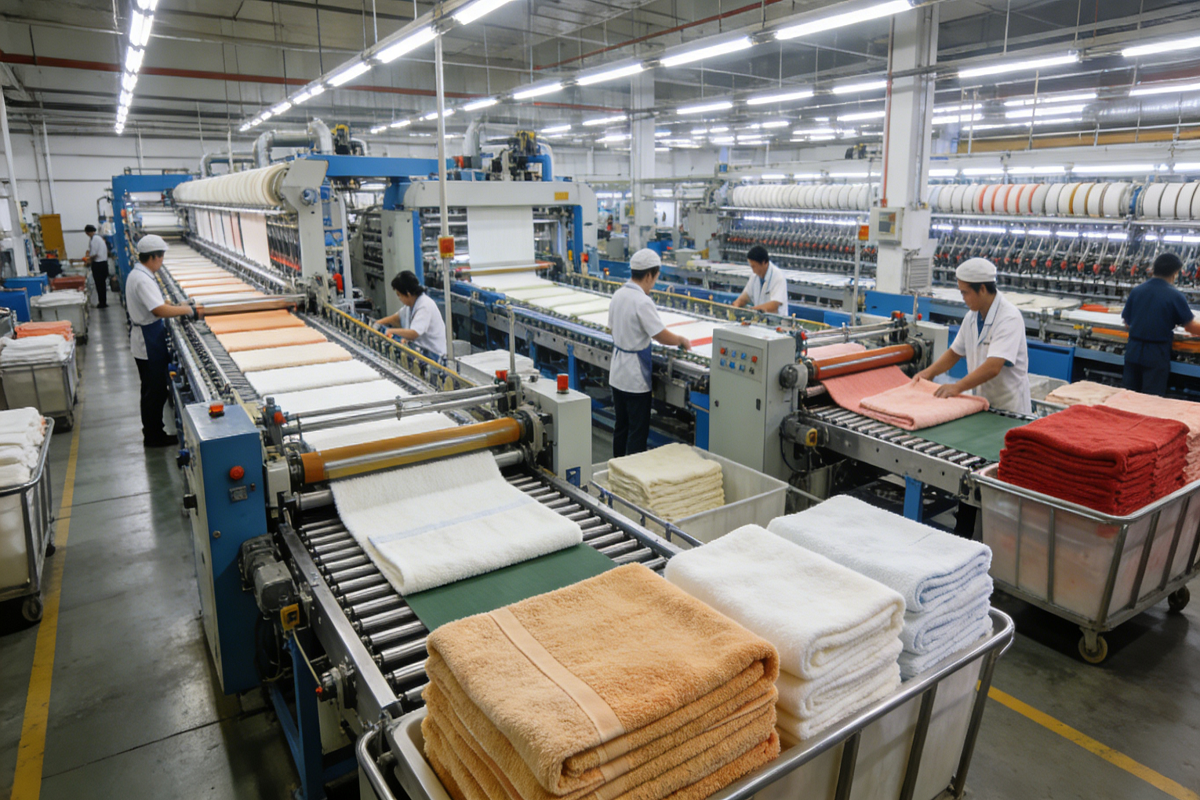
Raw materials directly influence the performance and reputation of exported towels. Cotton remains the most widely used fiber in towel manufacturing due to its softness and absorbency. High-grade cotton fibers produce towels that are more durable and comfortable.
Manufacturers should focus on:
Long-staple cotton for better strength and softness
Consistent yarn quality for uniform weaving
Reliable suppliers for stable production
Using premium raw materials reduces defect rates and helps meet the expectations of international markets where product quality is closely scrutinized.
The weaving stage is one of the most critical steps in towel production. Modern towel looms are capable of producing high-density terry fabric with consistent loop formation, which determines the towel’s absorbency and softness.
To optimize weaving operations, manufacturers should:
Invest in high-speed terry weaving machines
Monitor warp tension and yarn feeding systems
Implement automated monitoring for fabric defects
Automation in weaving helps reduce human error while improving production speed. Efficient weaving processes also minimize fabric waste and ensure uniform product quality.
After weaving and dyeing, towels move to the sewing stage where edges are hemmed and reinforced. Strong seams are essential for durability, particularly in export markets where towels must withstand repeated washing and heavy use.
To improve sewing efficiency:
Use high-speed industrial towel sewing machines
Standardize stitch length and thread tension
Implement automated folding and hemming systems
Well-maintained sewing machines produce cleaner seams and reduce thread breakage. This ensures towels meet durability standards required by global retailers.
Color consistency is a major factor for export buyers, especially for branded retail products. Inconsistent dyeing can lead to rejected shipments and costly production losses.
Manufacturers can improve dyeing performance by:
Using automated dyeing systems for precise color control
Monitoring water temperature and chemical balance
Implementing eco-friendly dyeing processes
Sustainable finishing methods are becoming increasingly important for international markets. Many global buyers prefer factories that follow environmentally responsible practices, including water recycling and reduced chemical usage.
Quality control is a critical component of an export-ready production line. Defective towels not only increase costs but also damage a manufacturer’s reputation in global markets.
A comprehensive quality inspection system should include:
Fabric inspection after weaving
Stitching and seam checks after sewing
Final product inspection before packaging
Quality control teams should evaluate absorbency, stitching strength, size consistency, and visual appearance. Using automated inspection technology can further improve accuracy and reduce inspection time.
An efficient production line reduces manufacturing costs and improves delivery speed. Poor workflow planning can create bottlenecks that slow production and increase labor costs.
To optimize workflow:
Arrange machines according to production sequence
Use conveyor systems or automated material handling
Monitor production data in real time
Lean manufacturing principles can also help eliminate unnecessary steps and reduce material waste. Efficient workflow design ensures that towel production remains consistent even during high-volume export orders.
Technology alone cannot guarantee production efficiency. Skilled workers are essential for maintaining machines, detecting problems early, and ensuring product quality.
Training programs should focus on:
Machine operation and maintenance
Quality inspection techniques
Production efficiency and safety procedures
Well-trained operators can significantly improve output while reducing machine downtime and production errors.
Export packaging must protect towels during long-distance transportation and meet the requirements of global retailers. Poor packaging can lead to damaged products, which negatively affects customer satisfaction.
Effective packaging strategies include:
Vacuum compression packaging to save shipping space
Moisture-resistant materials for protection
Clear labeling and barcoding for logistics
Efficient packaging not only protects products but also reduces shipping costs, which is an important factor in international trade.
Digital manufacturing systems are becoming increasingly important in modern textile factories. Production management software can track orders, monitor machine performance, and analyze production efficiency.
Key benefits of digital systems include:
Real-time production monitoring
Faster decision-making for production adjustments
Improved inventory and supply chain management
Factories that adopt digital tools can respond more quickly to large export orders and changing market demands.
Optimizing a towel production line for global export requires a comprehensive approach that integrates high-quality materials, advanced machinery, efficient workflow, and strict quality control. Manufacturers that invest in modern technology and skilled workforce training can significantly improve their productivity and product consistency.
As global demand for high-quality towels continues to grow, factories that streamline their production processes and maintain international standards will gain a strong competitive advantage. By focusing on efficiency, sustainability, and product quality, towel manufacturers can build long-term partnerships with global buyers and expand their presence in international markets.

The TPET ET-6620 Automatic Pillow Cover Machine (US Type) is a high-efficiency, intelligent solution designed to revolutionize the production of American-style pillowcases, tailored to meet the demands of modern textile manufacturing. Built for speed...

The TPET ET-5816/GG 2nd Generation Automatic Terry Towel Length Hemming Machine is a state-of-the-art solution designed to revolutionize towel production efficiency and quality. As the main drafting unit of the industry standard “Automatic towe...

The ET-6628 Envelope Pillow Case Machine: A Milestone in Automated AB-Side Envelop Production From TPET Company.In the competitive landscape of modern textile manufacturing, efficiency, precision, and versatility are paramount. The ET-6628 Envelope P...

Equipped with advanced magnetic navigation technology, the autonomous vehicle ensures accurate path following and stable operation.

This automatic delivery vehicle is equipped with magnetic navigation technology and is designed for seamless integration with production lines.

 EN
EN