In the high-stakes world of bedding manufacturing, the quilt is the centerpiece. It’s the visual anchor of a bedroom and the primary driver of a customer’s tactile experience. For bedding factories, the transition from artisanal production to industrial scale requires more than just "bigger" machines—it requires intelligent, high-speed systems designed for precision, durability, and versatility. Whether you are producing lightweight summer coverlets or heavy-duty winter duvets, understanding the core features of industrial quilting machines is vital for optimizing your ROI and ensuring product consistency.
The hallmark of an industrial bedding factory is volume. Unlike single-needle long-arm machines used by hobbyists, industrial quilt machines typically utilize multi-needle bars.
Row Configuration: Modern machines often feature two or three rows of needles. This allows for complex geometric patterns to be sewn simultaneously across the entire width of the fabric.
Stitch Speed: Top-tier industrial machines operate at speeds ranging from 2,500 to 4,500 RPM. This ensures that large-scale production runs are completed in minutes rather than hours.
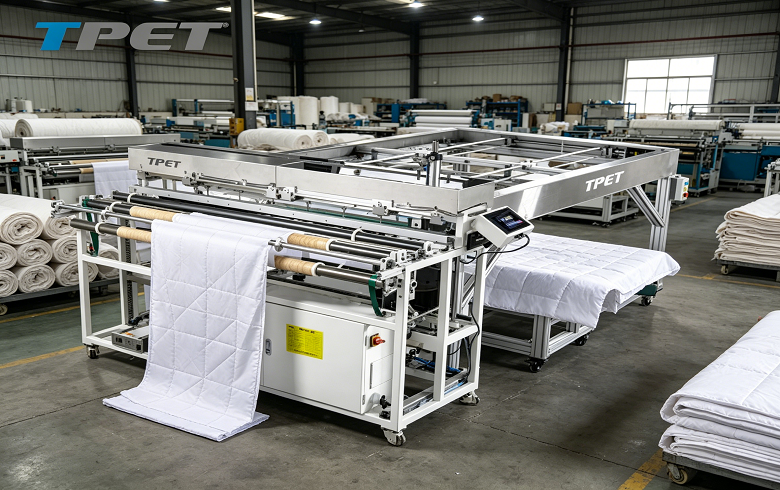
We have moved far beyond manual templates. Modern quilting is driven by CNC (Computer Numerical Control) technology.
Pattern Storage: Factories can store thousands of intricate "360-degree" patterns in the machine's onboard memory. Switching from a floral motif to a modern grid pattern is as simple as a few taps on a touch screen.
Automatic Pattern Scaling: If you are switching production from a Twin-sized quilt to a King-sized one, the software automatically scales the design parameters to ensure the borders and centering remain perfect.
Handling bulk is the greatest challenge in quilt manufacturing. A machine must manage the tension of the top thread, the bobbin thread, and the compression of the "sandwich" (top fabric, batting, and backing).
Active Tension Control: Sensors detect the thickness of the material in real-time. If the machine encounters a thicker patch of wool batting, it adjusts the tension to prevent thread snapping or "bird-nesting" on the underside.
Thread Break Sensors: In a factory setting, one broken thread can ruin 10 meters of fabric if not caught immediately. Industrial machines feature infrared or mechanical sensors that halt production instantly if a thread fails.
Bedding materials vary wildly—from silk and microfiber to thick down-alternative fills.
Industrial machines utilize puller feeds or conveyor belt systems rather than simple feed dogs. This ensures that the heavy quilt sandwich moves through the sewing area at a perfectly synchronized speed, preventing the layers from shifting or "creeping," which causes puckering.
To accommodate different "lofts" (thicknesses), the presser foot height must be adjustable.
Low Loft: For thin cotton coverlets.
High Loft: For "cloud-like" oversized comforters.
The ability to adjust this digitally ensures that the foot provides enough pressure to stabilize the fabric without crushing the delicate fibers of the batting.
Time spent changing bobbins is "dead time" in a factory. To combat this, industrial quilt machines use Jumbo or XXL Shuttle Hooks.
Comparison of Efficiency
| Feature | Standard Industrial Bobbin | Jumbo Shuttle Hook |
| Thread Capacity | Base Level | 2x to 3x More |
| Downtime | Frequent stops | Minimal interruptions |
| Stitch Consistency | Variable at high speeds | High stability for thick threads |
Efficiency doesn't end with the stitch; it ends with a finished product. High-end quilting lines often integrate the sewing machine with longitudinal and cross-cutting units.
Auto-Trimming: The machine automatically cuts the jump threads between patterns, reducing the need for manual "cleaning" by staff later.
Edge Trimming: As the quilted fabric exits the sewing area, integrated blades trim the excess batting and fabric to a precise width, preparing the quilt for the final binding stage.
For luxury bedding, the "tack and jump" feature is essential. Instead of a continuous line of stitching, the machine performs a reinforced "tack" in a specific spot, "jumps" to the next spot without sewing, and tacks again. This creates the tufted look common in high-end comforters, allowing the batting to remain loftier and softer.
An industrial machine is an investment meant to run 16 to 24 hours a day.
Automatic Lubrication: Centralized oiling systems ensure that all high-speed gears and needle bars stay lubricated without manual intervention, which also prevents oil spots from staining the white bedding fabric.
Vibration Dampening: Given the massive size of these machines (often 3 to 5 meters wide), heavy-duty steel frames and vibration-dampening mounts are crucial to maintain stitch precision at high speeds.
Safety is paramount in a factory environment. Modern machines include:
Optical Safety Curtains: If an operator reaches too close to the moving needle bar, the machine performs an emergency stop.
Remote Diagnostics: Many manufacturers now offer Wi-Fi-enabled machines. If an error occurs, technicians can log in remotely to diagnose software glitches or timing issues, drastically reducing downtime.
For a bedding factory, the "best" machine isn't just the fastest one; it's the one that balances speed, versatility, and ease of maintenance.
Investing in a machine with computerized multi-needle capabilities and jumbo shuttle hooks will provide the immediate boost in throughput needed to compete in the global market. As consumer trends shift toward more intricate patterns and sustainable, varying-loft materials, having a machine that can adapt via software rather than manual hardware changes is the ultimate competitive advantage.
By focusing on these core features, factory owners can ensure their production line remains a seamless blend of industrial power and textile artistry.

The TPET ET-6620 Automatic Pillow Cover Machine (US Type) is a high-efficiency, intelligent solution designed to revolutionize the production of American-style pillowcases, tailored to meet the demands of modern textile manufacturing. Built for speed...

The TPET ET-5816/GG 2nd Generation Automatic Terry Towel Length Hemming Machine is a state-of-the-art solution designed to revolutionize towel production efficiency and quality. As the main drafting unit of the industry standard “Automatic towe...

The ET-6628 Envelope Pillow Case Machine: A Milestone in Automated AB-Side Envelop Production From TPET Company.In the competitive landscape of modern textile manufacturing, efficiency, precision, and versatility are paramount. The ET-6628 Envelope P...

Equipped with advanced magnetic navigation technology, the autonomous vehicle ensures accurate path following and stable operation.

This automatic delivery vehicle is equipped with magnetic navigation technology and is designed for seamless integration with production lines.

 EN
EN