The global demand for towels—from hotel linens to household bath products—continues to grow steadily. As hospitality, healthcare, and retail sectors expand, manufacturers are investing in modern textile machinery to meet rising production needs. For entrepreneurs and textile businesses, purchasing a towel manufacturing machine can be a profitable step toward entering the textile production industry.
However, selecting the right equipment requires careful planning. From understanding production processes to evaluating machine types, costs, and long-term returns, investors must analyze several factors before making a purchase. This guide explains everything buyers need to know when investing in a towel manufacturing machine.
Before purchasing machinery, it is important to understand how towels are produced. Towel manufacturing is a multi-stage textile process involving yarn preparation, weaving, dyeing, cutting, and finishing.
The process usually includes the following stages:
Yarn Preparation – Cotton fibers are processed using carding and spinning machines to create yarn suitable for weaving.
Weaving – Terry towel looms produce the distinctive looped fabric that gives towels their absorbency.
Dyeing and Finishing – Jet dyeing machines and finishing systems ensure color consistency and softness.
Cutting and Sewing – Fabric is cut to size and stitched using industrial sewing machines.
Inspection and Packaging – Finished towels are inspected, folded, and packaged for distribution.
Each stage relies on specialized machinery, and the quality of the final product depends heavily on the reliability of these machines. Even if one piece of equipment is outdated, it can negatively impact the entire production line.
When investing in towel production equipment, buyers should understand the different types of machines used in the process. Each machine plays a specific role in producing high-quality towels.
The terry towel loom is the core machine in towel production. It creates the looped pile fabric that gives towels their absorbent structure.
Modern terry looms—such as air-jet or rapier looms—offer several advantages:
High weaving speed
Consistent loop formation
Reduced fabric defects
Increased productivity
These machines are essential for producing bath towels, hand towels, and washcloths in large quantities.
Dyeing machines ensure towels achieve uniform color and softness. Jet dyeing systems are commonly used because they provide efficient dye penetration and reduce fabric damage.
High-quality dyeing equipment can significantly improve product consistency and customer satisfaction.
Once woven and dyed, towel fabrics must be cut into precise dimensions. Automated cutting or slitting machines perform this task quickly and accurately.
These machines help maintain production efficiency while minimizing material waste.
Industrial sewing machines are used to stitch edges and hems, ensuring durability and a professional finish.
Depending on production scale, manufacturers may choose:
Manual hemming machines
Semi-automatic sewing machines
Fully automated hemming systems
Manual machines are inexpensive but slow, while automated systems deliver higher output and consistency.
The final stage of towel production often includes automated folding and packaging machines. These systems prepare towels for retail or wholesale distribution and reduce manual labor requirements.
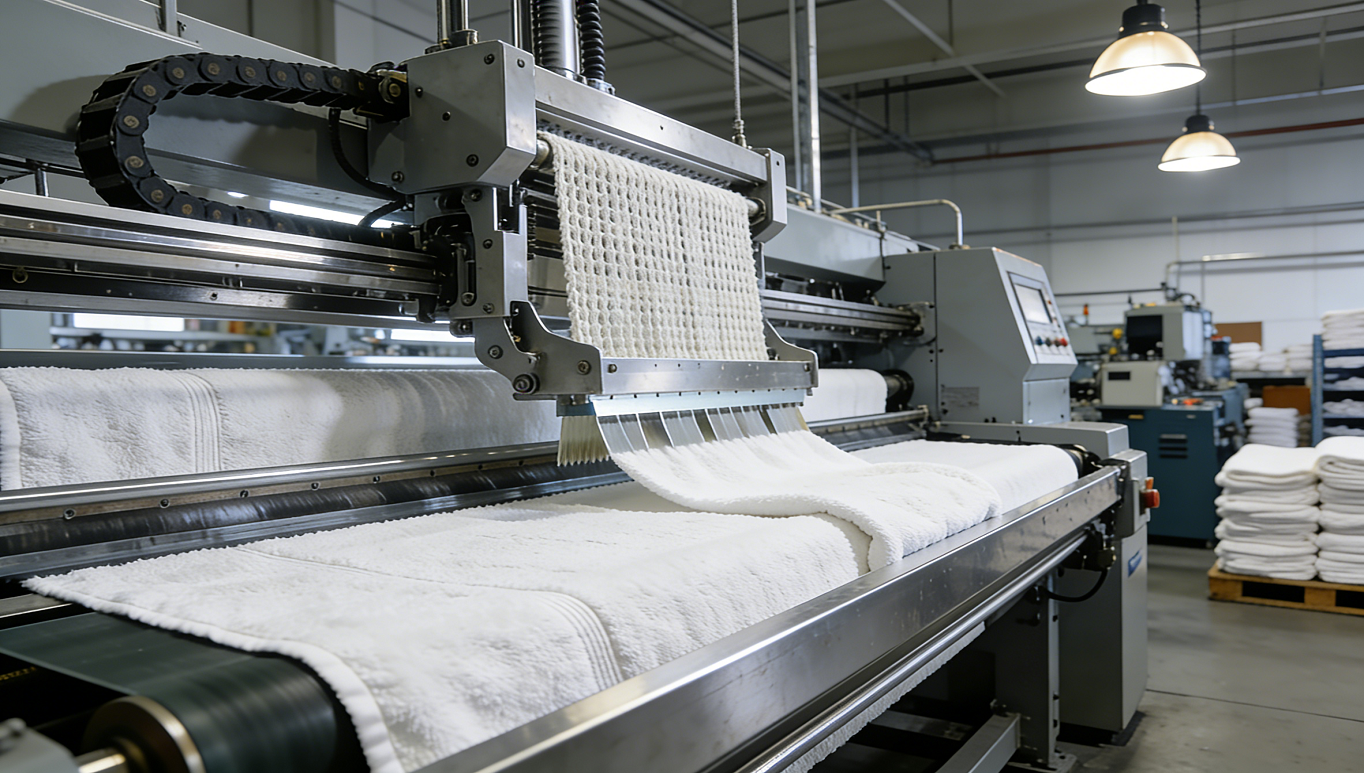
When investing in towel manufacturing machinery, one of the most important decisions is choosing between manual, semi-automatic, and fully automatic systems.
Manual equipment is suitable for small workshops or startups.
Advantages include:
Low upfront investment
Simple operation
Easy maintenance
However, production capacity is limited—often only 10–20 towels per hour—making it unsuitable for large-scale manufacturing.
Semi-automatic machines combine mechanical automation with manual oversight.
Benefits include:
Moderate production speed
Lower cost compared to full automation
Flexible production capabilities
These systems typically produce around 50–100 towels per hour, making them suitable for mid-sized manufacturers.
Fully automated systems integrate multiple processes such as feeding, weaving, cutting, folding, and packaging.
Advantages include:
High productivity
Reduced labor costs
Consistent product quality
Automated towel machines can produce more than 300 units per hour depending on configuration.
The price of towel production machinery varies widely depending on automation level, machine size, and brand reputation.
Typical price ranges include:
Entry-level manual machines: $3,000 – $10,000
Semi-automatic production lines: $15,000 – $50,000
Fully automatic systems: $80,000 – $200,000+
Some large industrial installations can exceed several hundred thousand dollars due to advanced automation and integrated production capabilities.
Investing in towel manufacturing equipment requires careful evaluation of several technical and financial factors.
Buyers should first determine the expected output. A small local supplier may only need a few hundred towels per day, while export-oriented factories may require thousands.
Matching machine capacity to market demand helps avoid unnecessary investment.
Automation increases efficiency but also raises equipment costs. Companies should balance labor costs, production targets, and investment budgets when choosing automation levels.
High-quality machines often include better materials, advanced control systems, and imported components. These features may increase purchase costs by 20–30% but improve reliability and lifespan.
Energy efficiency is another critical factor. Textile machinery consumes significant electricity, so selecting machines with lower power requirements can reduce operating costs over time.
Working with an experienced equipment manufacturer is essential. Reliable suppliers typically provide:
Technical support
Installation assistance
Operator training
Spare parts availability
Buyers should also request machine testing or factory visits before finalizing purchases.
A towel manufacturing machine is a long-term investment. Buyers should calculate the expected return on investment before purchasing equipment.
Key ROI factors include:
Production volume
Raw material costs (cotton yarn)
Labor expenses
Energy consumption
Equipment maintenance
High-efficiency machines often recover their investment faster because they increase output and reduce waste.
Buying machinery is only part of establishing a towel manufacturing facility. Investors must also consider other expenses, including:
Factory space or construction
Raw materials and yarn inventory
Skilled operators and technicians
Utility infrastructure (power, water, steam)
Logistics and distribution
Proper planning ensures smooth operations once production begins.
Investing in a towel manufacturing machine can open significant opportunities in the textile industry. With global demand for towels continuing to grow, manufacturers who adopt efficient production technology can achieve strong profitability.
However, success depends on selecting the right equipment. Buyers should evaluate machine types, automation levels, supplier credibility, and long-term operating costs before making a purchase. By carefully planning their investment and choosing reliable machinery, manufacturers can build a productive and scalable towel production line that meets both domestic and international market demand.

The TPET ET-6620 Automatic Pillow Cover Machine (US Type) is a high-efficiency, intelligent solution designed to revolutionize the production of American-style pillowcases, tailored to meet the demands of modern textile manufacturing. Built for speed...

The TPET ET-5816/GG 2nd Generation Automatic Terry Towel Length Hemming Machine is a state-of-the-art solution designed to revolutionize towel production efficiency and quality. As the main drafting unit of the industry standard “Automatic towe...

The ET-6628 Envelope Pillow Case Machine: A Milestone in Automated AB-Side Envelop Production From TPET Company.In the competitive landscape of modern textile manufacturing, efficiency, precision, and versatility are paramount. The ET-6628 Envelope P...

Equipped with advanced magnetic navigation technology, the autonomous vehicle ensures accurate path following and stable operation.

This automatic delivery vehicle is equipped with magnetic navigation technology and is designed for seamless integration with production lines.

 EN
EN