In the competitive landscape of the 2026 textile industry, the phrase "time is money" has been replaced by a more nuanced reality: "efficiency is survival." As consumer demands for home decor and bedding reach new heights of customization and quality, the traditional factory model is undergoing a radical transformation. At the heart of this revolution is the Automatic Home Textile Machine.
Moving away from manual, labor-intensive processes toward fully automated systems is no longer a choice for medium-to-large-scale factories—it is the baseline for staying relevant. This guide explores how modernizing with automation redefines production, quality, and the bottom line.
In a traditional setup, the production of a single comforter involves multiple hand-offs: cutting the fabric, layering the batting, manual pinning, and the slow, arduous process of guiding a heavy "sandwich" through a stationary needle. Each step is a potential bottleneck.
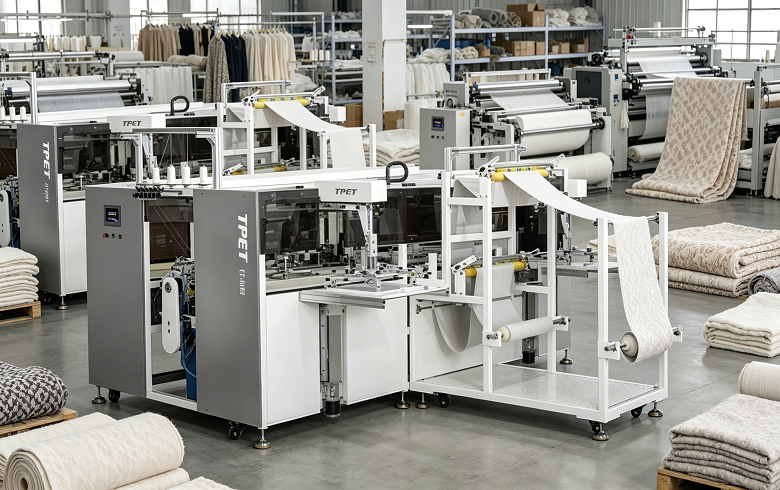
Automatic Home Textile Machines solve this through integration. Modern "all-in-one" systems can perform:
Automatic Unwinding: Precisely pulling fabric from giant industrial rolls.
Layer Alignment: Using laser sensors to ensure the top, middle, and bottom layers are perfectly centered.
Continuous Quilting: Sewing the design across thousands of meters of fabric without a single pause.
By removing the need for manual transport between stations, factories can increase their daily throughput by as much as 400%.
Human error is an inherent part of manual sewing. Even the most skilled operator will eventually experience fatigue, leading to slightly crooked seams or uneven tension.
Modern automatic machines utilize CNC (Computer Numerical Control) technology. This allows the needle head to move with sub-millimeter precision. Whether the design is a simple diamond quilt or an incredibly complex floral motif with varying stitch lengths, the machine executes it flawlessly every time.
Earlier generations of machines were limited in their movement. Modern automatic units feature rotating sewing heads. This allows the machine to sew in any direction—forward, backward, or sideways—without turning the fabric. This capability is essential for the intricate "tack and jump" patterns found in luxury European-style bedding
One of the biggest misconceptions about automation is that it limits creativity. In reality, it expands it. A single automatic home textile machine can be reprogrammed in seconds to handle a vast array of products:
Mattress Protectors: High-speed, high-tension stitching for durability.
Summer Coverlets: Delicate, low-loft patterns for lightweight fabrics.
Winter Duvets: High-clearance presser feet designed to handle thick down-alternative fills.
This versatility allows a factory to pivot its entire production line based on seasonal demand without purchasing new hardware.
Sustainability is a massive driver in the 2026 market. Automatic machines contribute to "green" manufacturing by drastically reducing material waste.
Pattern Nesting: The software calculates the most efficient way to lay out patterns on a roll of fabric to minimize "dead space."
Precision Trimming: Integrated automatic cutters trim the edges of the quilted material with such accuracy that the "fuzz" or scrap left over is minimal compared to manual hand-cutting.
One of the most frustrating aspects of textile production is the "bird-nest" or thread break. In an automatic system, these issues are managed by an array of sensors:
| Feature | Function | Benefit |
| Electronic Tensioners | Adjusts thread pull based on fabric thickness. | Prevents puckering on thin silks. |
| Infrared Break Sensors | Stops the machine instantly if the thread snaps. | Prevents "ghost sewing" that ruins fabric. |
| Automatic Bobbin Changers | Swaps empty bobbins for full ones mid-cycle. | Eliminates downtime during long runs. |
The rise of social media and "fast home fashion" means trends change in weeks, not years. An automatic machine allows a factory to be agile. If a specific geometric pattern goes viral, a designer can create the CAD file in the morning, upload it to the machine via USB or Wi-Fi, and have a production run finished by the afternoon.
This speed-to-market is the ultimate competitive advantage in the modern textile era.
Modernizing your production with an automatic home textile machine is more than an equipment upgrade—it is a total reimagining of what your factory can achieve. By embracing the synergy of CNC precision, IoT intelligence, and high-speed mechanical engineering, manufacturers can deliver the "luxury" quality consumers crave at a "mass-market" speed.
The future of bedding isn't just about the fabric; it's about the technology that weaves it together.

The TPET ET-6620 Automatic Pillow Cover Machine (US Type) is a high-efficiency, intelligent solution designed to revolutionize the production of American-style pillowcases, tailored to meet the demands of modern textile manufacturing. Built for speed...

The TPET ET-5816/GG 2nd Generation Automatic Terry Towel Length Hemming Machine is a state-of-the-art solution designed to revolutionize towel production efficiency and quality. As the main drafting unit of the industry standard “Automatic towe...

The ET-6628 Envelope Pillow Case Machine: A Milestone in Automated AB-Side Envelop Production From TPET Company.In the competitive landscape of modern textile manufacturing, efficiency, precision, and versatility are paramount. The ET-6628 Envelope P...

Equipped with advanced magnetic navigation technology, the autonomous vehicle ensures accurate path following and stable operation.

This automatic delivery vehicle is equipped with magnetic navigation technology and is designed for seamless integration with production lines.

 EN
EN