Setting up a terry towel production line is a complex industrial undertaking that requires careful planning, precise engineering, and a deep understanding of both textile manufacturing and operational efficiency. Terry towels—known for their looped pile structure that gives them high absorbency and softness—are widely used in households, hotels, spas, and commercial facilities.
Because of their high demand and competitive market pricing, manufacturers must design production lines that maximize output, minimize waste, ensure consistent quality, and maintain cost efficiency.
This article explores the essential stages of planning a terry towel production line, from raw material selection to weaving, finishing, quality control, and logistics. It also highlights the key factors that influence efficiency and long-term profitability.
Before designing any production line, it is critical to define the target product range. Terry towels come in various forms, such as bath towels, hand towels, face towels, beach towels, and hotel-grade premium towels. Each category has different specifications in terms of GSM (grams per square meter), pile height, yarn type, softness, absorbency, and durability.
For example, luxury hotel towels typically require higher GSM (500–700 GSM), double loops, and combed cotton yarn, while promotional or budget towels may use lower GSM and blended fibers to reduce cost. Defining these parameters early helps determine machinery selection, production speed, and finishing processes.
Market positioning also influences design decisions. A manufacturer targeting high-end export markets will prioritize quality control systems and advanced finishing equipment, whereas a mass-market producer will focus more on high-speed output and cost reduction.
The foundation of any terry towel is the yarn. Cotton remains the most widely used raw material due to its natural absorbency and softness. However, blends with polyester or bamboo fibers are also common for enhancing durability or reducing cost.
The yarn preparation stage includes several key processes:
Cotton Baling and Opening: Raw cotton is first opened and cleaned to remove impurities such as dust, seeds, and debris. Efficient opening systems improve downstream spinning performance.
Carding and Combing: Carding aligns fibers into a continuous web, while combing removes short fibers to improve yarn strength and smoothness. Combed cotton yarn is essential for premium towels.
Spinning: The cleaned fibers are spun into yarn using ring spinning or rotor spinning machines. Ring spinning is preferred for high-quality towels due to its superior yarn strength and softness, although rotor spinning offers higher productivity.
Winding and Warping: The yarn is wound into packages and prepared into warp beams for weaving. Efficient warping systems ensure uniform tension and reduce breakage during weaving.
At this stage, efficiency is achieved by minimizing yarn defects, maintaining consistent tension, and reducing machine downtime.
Weaving is the core stage of terry towel production. It determines the structure, softness, and absorbency of the final product. Terry towels are typically produced using rapier looms or air-jet looms equipped with terry attachments.
Loom Selection: Air-jet looms offer extremely high speed and are suitable for large-scale production, but they may require higher maintenance and energy consumption. Rapier looms are more flexible and better suited for complex patterns and varied towel designs.
Terry Formation: The unique loop structure of terry towels is created by controlling the ground and pile warp yarns. The pile yarn forms loops that give the towel its absorbent surface. Precision in loop height is crucial for balancing softness and durability.
Efficiency Considerations: High-speed looms increase output but require stable yarn quality to avoid breakage. Automated defect detection systems reduce fabric waste. Optimized loom scheduling minimizes idle time between style changes.
Modern weaving departments often integrate digital monitoring systems to track production efficiency, yarn consumption, and machine performance in real time.
After weaving, the grey fabric undergoes dyeing. This stage significantly affects both product appeal and production efficiency.
There are two primary dyeing approaches:
Piece Dyeing: The entire fabric roll is dyed after weaving. This method is flexible and widely used for towels because it allows large batch processing.
Yarn Dyeing: Yarn is dyed before weaving, enabling intricate patterns and striped designs but increasing production complexity.
Efficiency in dyeing depends on several factors:
Color consistency is critical in towel production, especially for hotel and retail markets. Even minor variations can lead to rejected batches, increasing cost and reducing efficiency.
Terry towels must undergo finishing treatments to achieve softness, brightness, and absorbency.
Bleaching: Removes natural impurities and prepares fabric for dyeing or whitening. Oxygen-based bleaching is often preferred for environmental and fabric safety reasons.
Washing: Multiple washing cycles remove residual chemicals and improve fabric purity.
Softening: Silicone-based or enzyme-based softeners are applied to enhance hand feel and comfort. However, overuse of softeners can reduce absorbency, so precise control is required.
Efficient finishing lines use continuous processing systems that integrate washing, bleaching, and softening in a single flow, reducing handling time and water consumption.
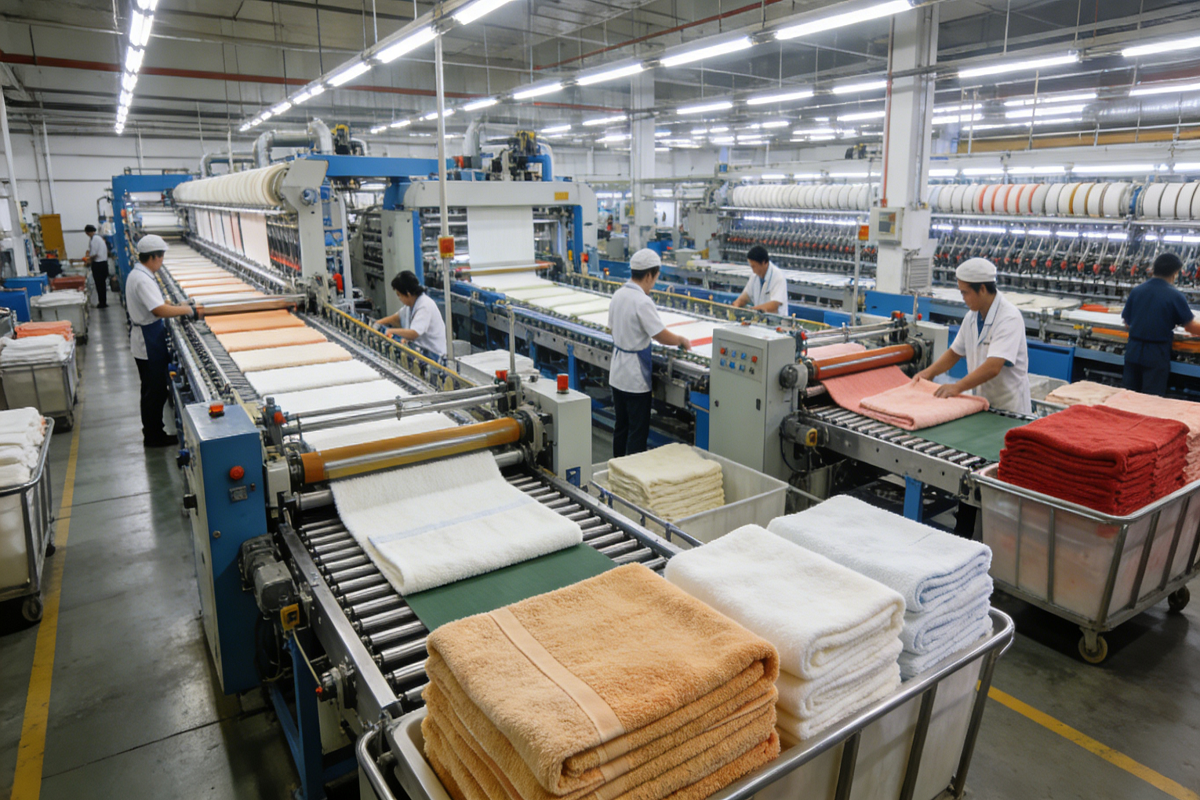
After finishing, the fabric is dried and prepared for final product assembly.
Drying: Industrial tumble dryers or continuous drying machines are used to reduce moisture content. Energy efficiency is a key consideration, as drying consumes significant power.
Cutting: Fabric is cut into standardized towel sizes using automated cutting machines. Precision cutting reduces material waste and improves consistency.
Sewing and Hemming: Edges are stitched using overlock or lockstitch machines to prevent fraying. High-speed sewing lines with skilled operators or automated sewing robots can greatly improve productivity.
Lean manufacturing principles are often applied here to reduce bottlenecks and ensure smooth workflow between cutting and sewing stations.
Quality control is a critical component throughout the entire terry towel production process, ensuring that each stage meets strict manufacturing standards. From raw yarn inspection to weaving and finishing, key parameters such as GSM (grams per square meter), loop integrity, pile height consistency, and fabric strength are continuously monitored. These measurements help guarantee that the towels achieve the required softness, durability, and overall performance expected by customers.
In addition to physical testing, chemical and functional evaluations are also essential. Color fastness testing ensures that dyes do not fade or bleed during washing, while shrinkage tests confirm dimensional stability after laundering. Absorbency testing verifies the towel’s ability to efficiently retain moisture, and final visual inspections detect defects such as stains, holes, or uneven stitching. Increasingly, automated vision inspection systems are being integrated into production lines, enabling real-time defect detection, reducing human error, and lowering inspection costs.
Once towels pass final quality inspection, they move into the packaging stage, where efficiency and presentation both play important roles. Automated folding machines ensure that each towel is uniformly folded, improving product appearance and maximizing space utilization. Compression packing systems are often used to reduce packaging volume, which helps lower shipping costs and improve container loading efficiency.
Logistics optimization is equally important in ensuring timely and cost-effective delivery. Modern warehouses use real-time inventory tracking systems and optimized layout designs to streamline storage and retrieval processes. Barcode systems help improve traceability and reduce handling errors. For export-oriented manufacturers, compliance with international packaging standards is essential to prevent customs delays and minimize product damage during long-distance transportation.
Modern terry towel production lines are increasingly adopting automation and smart manufacturing technologies to enhance efficiency and precision. Enterprise Resource Planning (ERP) systems help coordinate production schedules, manage inventory, and optimize resource allocation. Meanwhile, IoT-enabled machines provide real-time monitoring of equipment performance, allowing operators to quickly detect anomalies and maintain stable production conditions.
Advanced technologies such as AI-based predictive maintenance further improve operational efficiency by forecasting machine failures before they occur, thereby reducing downtime. Automated material handling systems also minimize manual labor requirements and improve workflow consistency. Overall, smart manufacturing not only boosts productivity but also generates valuable data insights that support continuous improvement and long-term competitiveness.
Even with increasing automation, skilled labor remains a vital part of terry towel manufacturing. Operators are responsible for machine operation, process supervision, and troubleshooting, all of which require a strong understanding of equipment behavior and production standards. Without proper training, even advanced machinery cannot perform at its full potential.
Effective workforce training programs focus on multiple key areas, including machine maintenance, quality inspection techniques, workplace safety, and lean manufacturing principles. Continuous education ensures that employees can adapt to new technologies and process improvements. Strong workforce management ultimately leads to smoother production flow, reduced error rates, and significantly higher overall productivity across the manufacturing system.
Planning a terry towel production line for maximum efficiency requires a holistic approach that integrates raw material selection, advanced machinery, optimized workflow design, quality control systems, and smart manufacturing technologies. Every stage—from yarn preparation to final packaging—must be carefully engineered to minimize waste, reduce downtime, and maintain consistent product quality.
In a highly competitive global textile market, efficiency is not just about producing more towels; it is about producing better towels at lower cost with faster turnaround times. Manufacturers who successfully integrate automation, process optimization, and quality management will be best positioned to achieve long-term success and sustainability in the terry towel industry.

The TPET ET-6620 Automatic Pillow Cover Machine (US Type) is a high-efficiency, intelligent solution designed to revolutionize the production of American-style pillowcases, tailored to meet the demands of modern textile manufacturing. Built for speed...

The TPET ET-5816/GG 2nd Generation Automatic Terry Towel Length Hemming Machine is a state-of-the-art solution designed to revolutionize towel production efficiency and quality. As the main drafting unit of the industry standard “Automatic towe...

The ET-6628 Envelope Pillow Case Machine: A Milestone in Automated AB-Side Envelop Production From TPET Company.In the competitive landscape of modern textile manufacturing, efficiency, precision, and versatility are paramount. The ET-6628 Envelope P...

Equipped with advanced magnetic navigation technology, the autonomous vehicle ensures accurate path following and stable operation.

This automatic delivery vehicle is equipped with magnetic navigation technology and is designed for seamless integration with production lines.

 EN
EN