In the world of interior design and flooring, the difference between a remnant and a high-end area rug often comes down to the finish. Carpet serging is the process of wrapping the edge of a carpet with a dense, continuous loop of yarn, creating a look that mimics traditional handmade rugs.
Unlike standard binding, which uses a synthetic tape, serging provides a "high-end" aesthetic that is both structurally superior and visually integrated. In 2026, as custom-shaped rugs and high-traffic commercial mats dominate the market, the industrial carpet serging machine has become a vital asset for flooring professionals.
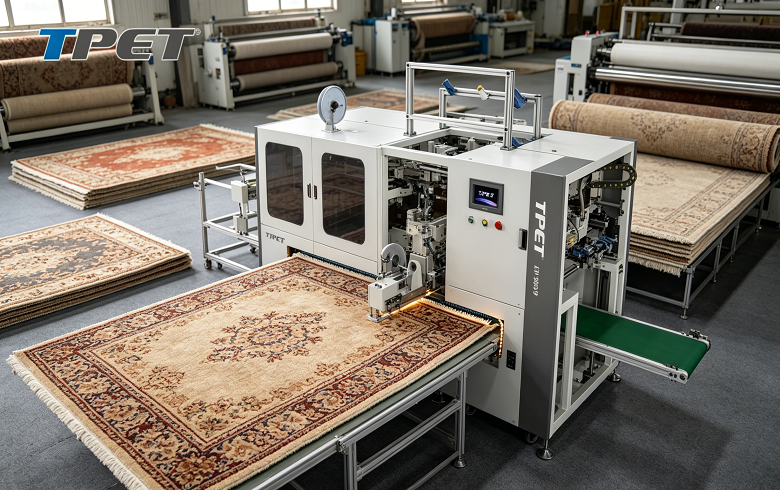
Carpet serging (sometimes called "overlocking") uses a specialized heavy-duty machine that loops yarn over the edge of the carpet. This creates a rounded, whip-stitched appearance that is roughly 3/8" to 1/2" wide.
The Yarn Loop: The machine typically uses two or three threads—a heavy serging yarn for the visible edge and a finer "filler" or "tension" thread to secure the back.
Structural Integrity: Serging "encases" the raw edge, preventing the secondary backing of the carpet from separating from the pile.
Customization: Because it uses yarn, manufacturers can perfectly match the serging color to the carpet's primary fibers, making the edge nearly invisible or adding a contrasting accent color.
To handle the extreme density of modern carpets—especially those with heavy latex or jute backings—a serger must possess significant mechanical power.
Industrial sergers, such as those produced by Union Special or NC Carpet Binding, utilize specialized needles (like the System 190R) that are thick enough to punch through thick piles without deflecting. A machine with a high-torque servo motor is essential for maintaining a constant stitch length when transitioning from a thin low-pile carpet to a thick shag.
Because rugs are heavy and the pile can be slippery, a top-and-bottom feed (walking foot) system is non-negotiable. This prevents the top layer of the carpet from "crawling" or bunching, ensuring the loops are laid down with mathematical precision.
Premium area rugs can be over an inch thick. Modern sergers offer a presser foot lift of up to 20mm, allowing the operator to slide heavy mats under the needle without crushing the pile.
| Method | Appearance | Durability | Best For |
| Serging | Braided/Whip-stitched | Very High | High-end area rugs, custom designs. |
| Binding | Fabric/Synthetic Tape | Moderate | Wall-to-wall remnants, quick fixes. |
| Fringing | Tassels/Decorative | Low (Maintenance) | Oriental-style rugs, decorative pieces. |
The biggest trend in 2026 is the rise of the Portable Carpet Serger.
On-Site Customization: These units allow installers to finish a custom-cut rug directly in a client's home or office. This eliminates the need to transport heavy rugs back to a workshop, saving time and logistics costs.
Table-Mounted Stability: For high-volume production, table-mounted machines with power pullers remain the standard. The puller assists the operator by mechanically drawing the heavy rug through the machine, ensuring the stitch remains consistent over a 20-foot run.
Carpet serging is one of the "dirtiest" forms of sewing. The friction of the yarn and the cutting of the carpet backing create an immense amount of dust.
Vacuum Integration: 2026 industrial models often feature a built-in vacuum shroud that sucks away the trimmed carpet edge instantly.
Looper Lubrication: The loopers in a serger move in a complex elliptical path at high speed. Daily oiling of the looper race is required to prevent heat-related seizures.
Knife Sharpening: The machine trims the carpet just before serging. If the knives are dull, the yarn will wrap over a ragged edge, leading to a "fuzzy" finish. Inspect and sharpen knives every 10–15 rugs.
The strength of a serged edge depends as much on the yarn as the machine.
Wool Yarn: The gold standard for luxury. It is naturally flame-retardant and hides the stitches beautifully.
Polypropylene: Ideal for outdoor rugs or high-traffic commercial areas because it is stain-resistant and won't rot if exposed to moisture.
Cotton: Often used for a matte, modern look on flat-weave rugs.
A professional carpet serging machine is an investment in craftsmanship. It allows flooring businesses to transition from selling "scraps" to selling "custom furniture." By choosing a machine with walking-foot technology, high clearance, and robust motor power, you ensure that every rug you produce is as durable as it is beautiful.
In the 2026 market, where "bespoke" is the keyword, the serged edge is the final touch that defines a quality interior.

The TPET ET-6620 Automatic Pillow Cover Machine (US Type) is a high-efficiency, intelligent solution designed to revolutionize the production of American-style pillowcases, tailored to meet the demands of modern textile manufacturing. Built for speed...

The TPET ET-5816/GG 2nd Generation Automatic Terry Towel Length Hemming Machine is a state-of-the-art solution designed to revolutionize towel production efficiency and quality. As the main drafting unit of the industry standard “Automatic towe...

The ET-6628 Envelope Pillow Case Machine: A Milestone in Automated AB-Side Envelop Production From TPET Company.In the competitive landscape of modern textile manufacturing, efficiency, precision, and versatility are paramount. The ET-6628 Envelope P...

Equipped with advanced magnetic navigation technology, the autonomous vehicle ensures accurate path following and stable operation.

This automatic delivery vehicle is equipped with magnetic navigation technology and is designed for seamless integration with production lines.

 EN
EN