In the competitive landscape of 2026, scaling a bedding business requires moving beyond the limitations of manual labor. As consumer demand for high-quality, sustainably produced linens grows, the industrial pillowcase machine has become the cornerstone of the modern factory. Transitioning from a series of individual sewing stations to an integrated, automated system is the most effective way to ensure consistency, reduce waste, and maximize profit margins.
For many startup bedding brands, production begins with skilled artisans using standard industrial lockstitch machines. While this allows for high craftsmanship, it creates several scaling bottlenecks:
Speed Inconsistency: A manual operator’s speed fluctuates throughout the day due to fatigue.
Seam Variability: Even the best tailors will have slight variations in seam allowance over hundreds of units, leading to size discrepancies in the final product.
High Labor Costs: In a global market, the labor-to-product ratio of manual sewing makes it difficult to compete on price without sacrificing quality.
An industrial pillowcase machine—specifically a semi-automatic or fully automatic hemming line—removes these variables by automating the most time-consuming parts of the process.
To choose the right equipment, you must understand where your current bottleneck lies. Most scaling businesses utilize a combination of the following three machine types:
These are the heavy hitters of the industry. These machines take a roll of fabric and perform the "hem-sew-cut" cycle without human intervention.
Output: Can produce between 150 to 300 pillowcases per hour.
Precision: Uses laser sensors to align the fabric edges, ensuring a perfect $90^{\circ}$ hem every time.
For businesses focusing on durability, an industrial 4-thread or 5-thread overlocker is essential. These machines trim the raw edge of the fabric and encase it in thread simultaneously, preventing the internal fraying that can occur with frequent industrial washing.
If your brand identity relies on "topstitching" or decorative flanges, a double-needle machine allows you to sew two perfectly parallel lines in a single pass. This doubles your output speed for decorative elements compared to a single-needle machine.
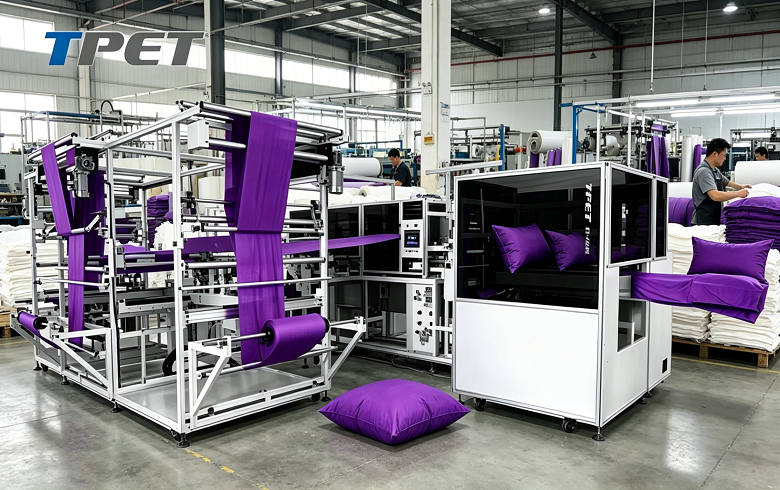
Modernizing with a brand like TEPT in 2026 brings digital advantages that were unavailable just five years ago.
Digital Tension Control: Instead of manual knobs, operators use a touch-screen interface to set "recipes" for different fabrics. Moving from a 200-thread-count cotton to a 600-thread-count sateen takes seconds, not minutes.
IoT Monitoring: Factory managers can track the "Real-Time Stitch Count" and "Down-Time Analytics" from a mobile app. This allows you to identify which machine needs maintenance before it actually breaks.
Automatic Thread Trimmers (UBT): These reduce thread waste by up to 25% by cutting the thread exactly at the end of the seam, eliminating the need for manual "sniping" by the operator.
| Metric | Manual Production | Automated Production |
| Labor Requirement | 4-5 Operators | 1 Operator |
| Reject Rate | 5% - 8% | < 1% |
| Material Waste | High (Human error) | Minimal (Precision cutting) |
| Scalability | Linear (More staff needed) | Exponential (Add more shifts) |
An industrial machine is a precision instrument. To maintain its value, a factory must implement a strict maintenance protocol:
Lint Management: Bedding fabrics generate massive amounts of lint. Automated suction systems are a must-have feature to prevent "clogging" of the internal gears.
Needle Calibration: In high-speed production, needles heat up quickly. Using titanium-coated needles can reduce heat friction and prevent thread breakage.
Oil Quality: Modern machines use a "fully enclosed" oiling system. Checking the oil clarity weekly ensures that the high-speed loopers don't seize.
Scaling a bedding business in 2026 is no longer a matter of working harder; it is a matter of working smarter. An industrial pillowcase machine provides the structural foundation for a brand to transition from a local boutique to a global supplier. By reducing human error and increasing mechanical throughput, you ensure that every customer receives the same high-standard product, regardless of how fast your business grows.

The TPET ET-6620 Automatic Pillow Cover Machine (US Type) is a high-efficiency, intelligent solution designed to revolutionize the production of American-style pillowcases, tailored to meet the demands of modern textile manufacturing. Built for speed...

The TPET ET-5816/GG 2nd Generation Automatic Terry Towel Length Hemming Machine is a state-of-the-art solution designed to revolutionize towel production efficiency and quality. As the main drafting unit of the industry standard “Automatic towe...

The ET-6628 Envelope Pillow Case Machine: A Milestone in Automated AB-Side Envelop Production From TPET Company.In the competitive landscape of modern textile manufacturing, efficiency, precision, and versatility are paramount. The ET-6628 Envelope P...

Equipped with advanced magnetic navigation technology, the autonomous vehicle ensures accurate path following and stable operation.

This automatic delivery vehicle is equipped with magnetic navigation technology and is designed for seamless integration with production lines.

 EN
EN