In the competitive landscape of 2026, the difference between a profitable textile operation and a struggling one often comes down to a single factor: equipment reliability. For workshops focusing on towel production—ranging from high-pile luxury bath sheets to specialized microfiber or medical towels—the choice of a sewing machine is the most critical capital investment you will make.
As a leader in smart factory solutions, TEPT understands that sewing terry cloth isn't just about "stitching fabric." It is about managing a complex, high-friction material that creates massive amounts of lint and demands extreme mechanical precision. Choosing the wrong machine leads to "bird-nesting," skipped stitches, and constant downtime. Choosing the right one—especially a fully automated TEPT solution—is the key to scaling your business.
To select the right machine, you must first respect the material. Terry cloth (and its modern cousin, microfiber) is a "sandwich" of loops. When you sew it, you face three main enemies:
Compression & Loft: The high pile of a towel must be compressed by the presser foot to be sewn, but if the foot doesn't have a high enough "lift," the fabric will snag.
Elasticity: Towels are designed to be pulled and stretched. A standard lockstitch is rigid; it will snap the moment a user tugs on the hem.
The "Dust" Factor: Every cut and every stitch on a towel releases thousands of tiny fibers. In a standard machine, this lint migrates into the oil lines and sensors, causing catastrophic failure within weeks.
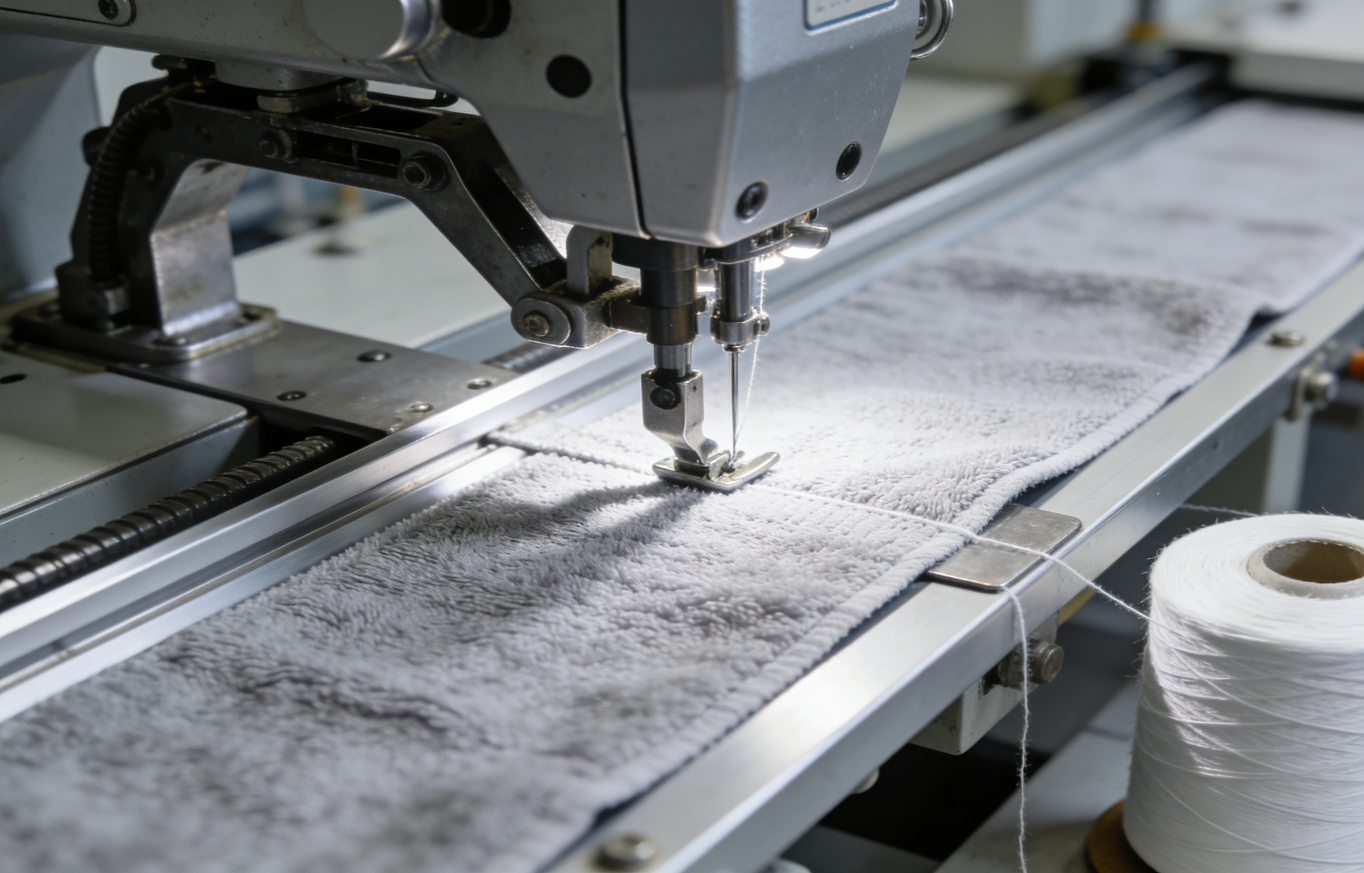
Your workshop needs a specific stitch type depending on which part of the towel you are finishing.
For the long sides of the towel, a 4-thread or 5-thread overlocker is the industry standard. This machine trims the raw edge while wrapping it in a durable thread "cage." TEPT’s automatic 4-side sewing lines utilize high-speed overlocking heads that can handle thousands of meters of fabric per day without losing stitch tension.
For the ends of the towel, a double-chainstitch is preferred. Because the thread loops through itself (rather than interlocking with a bobbin), the stitch has built-in "stretch." This ensures that the cross-hem remains intact even after hundreds of industrial wash-and-dry cycles.
When evaluating your next machine, look for these "Must-Have" technical specs that define a high-performance 2026 workshop.
A standard sewing machine usually has a lift of 5–8mm. For towels, this is insufficient. You need a high-lift presser foot (13mm to 16mm). This allows you to slide bulky "bath sheets" under the needle without the operator having to force the fabric, which preserves the pile's aesthetic.
Towels have a tendency to "creep"—where the top layer of fabric moves faster than the bottom layer. This results in a wavy, unprofessional hem. A differential feed allows you to adjust the speed of the feed dogs (the metal teeth under the fabric) independently. This ensures the towel exits the machine as flat as it entered.
In 2026, manual cleaning is an expensive waste of time. Premium machines, such as those integrated into TEPT’s fully automatic lines, feature vacuum suction at the trimming knife. This pulls the cut "fuzz" directly into a central waste canister, keeping the needle bar and looper clean and preventing oil stains on your product.
The most successful workshops are moving away from stand-alone manual machines and toward integrated automation.
Traditional "clutch motors" are loud and inefficient. Modern Direct Drive Motors are built into the sewing head itself. They use 70% less energy and provide the "Needle-Up/Needle-Down" positioning that is essential for high-speed production.
The newest generation of TEPT smart machines features sensors that detect fabric thickness in real-time. When the machine hits a "bulk point" (like where a side hem overlaps with a cross hem), the AI instantly increases the motor torque to pierce the fabric without a skipped stitch.
A sewing machine in a towel workshop is under more stress than in any other textile environment. To ensure longevity:
Needle Choice: Always use a Ball-Point (SES) needle. Sharp-point needles can cut the base threads of the towel, causing tiny holes that expand over time.
Blade Quality: The dense loops of terry cloth dull steel quickly. Always use Tungsten-Carbide knives for a clean, professional cut.
Lubrication: Use high-quality, clear paraffinic oil. Avoid yellowed oils that can stain the highly absorbent towel fibers.
At TEPT, we specialize in the "Smart Factory" evolution. Our Full Automatic Microfiber and Cotton Towel Machines aren't just sewing machines—they are complete production ecosystems. By combining automatic feeding, precise 4-side hemming, label insertion, and stacking into one footprint, we allow workshops to:
Reduce Labor Costs: One technician can oversee multiple TEPT lines.
Increase Consistency: Every towel is identical, whether it’s the first or the ten-thousandth.
Scale Rapidly: Our machines are designed for 24/7 operation with minimal maintenance downtime.
Selecting a machine for your towel workshop is a balance between your current output and your future ambitions. While a manual industrial overlocker is a good start, the future of the industry lies in the precision and labor-savings of TEPT's automated solutions.
By focusing on high-lift feet, differential feeds, and integrated lint management, you protect your bottom line and ensure that your brand is synonymous with quality. In the world of textiles, the finish is everything. Make sure your machinery is up to the task.

The TPET ET-6620 Automatic Pillow Cover Machine (US Type) is a high-efficiency, intelligent solution designed to revolutionize the production of American-style pillowcases, tailored to meet the demands of modern textile manufacturing. Built for speed...

The TPET ET-5816/GG 2nd Generation Automatic Terry Towel Length Hemming Machine is a state-of-the-art solution designed to revolutionize towel production efficiency and quality. As the main drafting unit of the industry standard “Automatic towe...

The ET-6628 Envelope Pillow Case Machine: A Milestone in Automated AB-Side Envelop Production From TPET Company.In the competitive landscape of modern textile manufacturing, efficiency, precision, and versatility are paramount. The ET-6628 Envelope P...

Equipped with advanced magnetic navigation technology, the autonomous vehicle ensures accurate path following and stable operation.

This automatic delivery vehicle is equipped with magnetic navigation technology and is designed for seamless integration with production lines.

 EN
EN